
Grade: C+
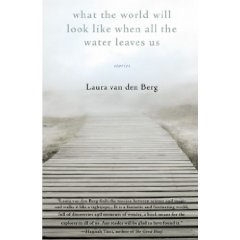
This is a collection of stories by Laura van den Berg, a writer whose talents, according to her book jacket, are “fully formed and spectacular”.
Her book jacket continues to make promises about the stories themselves, calling them “tender, elegant” (Benjamin Percy), “calm, wry, and compassionate” (Brock Clarke).
Ms. van den Berg received her MFA from Emerson College, a prestigious Boston college churning out artistic intellectuals with a rap sheet. Van den Berg’s stories have appeared in many places including Epoch, Best New American Voices 2010, and The Best American Nonrequired Reading 2008.
Van den Berg’s stories, true to the collection’s title, have elements in water running throughout. Hannah Tinti’s claim that she “finds the tension between science and magic and walks it like a tightrope” is very misleading. Her stories, while utilizing exotic travels to Africa (“The Rain Season”) and South America (title story and “goodbye my loveds”) and the people and creatures that dwell there , should not be confused for “magic”.
Her main characters, all female, carry the same voice regardless of who they are, what age they are, and how they are feeling. Van den Berg seems to lack the ability to fully form her characters, and instead they seem to be mere versions of herself. And she must be boring.
Van den Berg utilizes exotic places, animals, and customs to try to hide the fact that the stories and characters themselves are flat, underdeveloped, trite, and dull. Her attempts to display “the human condition” are often cliched and overdone. An older woman haves an affair with a younger man, a failed actress wanders to a strange place trying to find herself, many women nurse broken hearts, and so on.
In “where we must be”, said failed actress takes a job as a bigfoot impersonator and dates a terminally ill man named Jimmy. To van den Berg’s merit, Her main character’s life isn’t resolved and Jimmy doesn’t die at the end. A sappy “this is how I deal with the death of my boyfriend” story would have resulted in a never ending eye roll.
Her use of language is generally basic, nothing spectacular but she knows how to string together a sentence properly. She does, however, invoke some strong images in some of her lines, such as: “I bend over and press my hand between his shoulder blades, feeling the slender ligaments and bones a healthy body conceals.” Now if only it hadn’t followed something so over the top as “I’m being tested, I realize, to see how long I can endure suffering in another person.” Wait, where did the violins come from?
Another story, “we are calling to offer you a fabulous life”, probably should never have been written. It’s a story about a lonely woman having an affair with her boss, the owner of a mask store the narrator works at. He leaves her, she leaves the store with a stolen mask in hand.
Nothing happens. Really. Nothing.
The title of the story comes from a prank call made to the narrator. A call that has no importance to the story other than to repeat the theme that the narrator is a total loser. I find van den Berg makes this mistake repeatedly, inserting little things that are somewhat interesting in themselves, but has no place within the story. Another ploy to create a false sense that her stories are interesting or unique.
One of her stories, “inverness”, takes place in Scotland as another jilted woman nurses her jilted heart. She is looking for a rare flower, the twinflower, while other scientists search out the notorious Loch Ness monster. This might be an intriguing story if the narrator wasn’t constantly blubbering about her exboyfriend and breathing into his answering machine. Even when she finds the flower, it is wilted and unexciting (a metaphor for the narrator’s own dreams and aspirations, and I would argue, a metaphor for van den Berg’s writing).
In nearly all of her stories, van den Berg’s female narrators are weak, incapable of dealing with their own lives and tribulations, and irritatingly whiney. It would be one thing if van den Berg allowed these characters to grow and change throughout her stories, but she doesn’t. She leaves them as paralyzed with heartbreak or confusion as they are from the get-go.
The one story in which she attempts growth within her narrator is in the title story, where her high school aged narrator decides to leave her mother in South America to pursue her own dreams as a long distance swimmer in the United States. But her mother, a cold philandering self-obsessed scientist determined to follow a false theory, shows us another flat, flawed character. The mother has no positive attributes and remains steadfast to the end in her beliefs, allowing her daughter to leave without even a reaction. The daughter’s only real change is that during the story she does what her mother tells her, and at the end she doesn’t. A change, but not enough of a change. The narrator is also so poorly drawn that it is difficult to tell exactly what age she is (is it even legal for her to leave her mother?) or even what she looks like (this only matters in that one of her mother’s beaus makes the moves on her, but even this act is boring).
All in all, van den Berg relies too heavily on foreign countries and exotic items (masks, plants, animals) to carry her stories. Her characters are flat and annoying, and her writing, while obviously honed, lacks the luster it needs to be memorable.
 Bent Shelf Book Reviews