
Grade: A-
David Ebershoff is one of the few people who has really succeeded in his career. His name may not be automatically recognizable, but he has accomplished many things and his resume speaks volumes.
He is the author of three other books, The Danish Girl, The Rose City, and Pasadena, none of which I have read so I cannot comment.
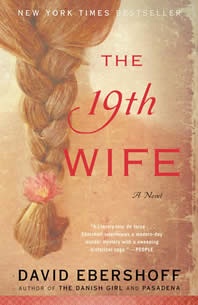
The 19th Wife, however, is an international bestseller and can be found in airports across the United States. His novels have been translated into many languages, won many awards, and two of his novels are being adapted for film. Yes, he is hot shit.
He has taught creative writing at New York University and Princeton, and currently teaches in the graduate writing program at Columbia University. Obviously all the fancy schools stand by him. He is also an editor-at-large at Random House.
He has basically won at life. He’s also a brilliant writer. The bastard.
The 19th Wife is a work of fiction which weaves historical facts into a narrative that is both compelling and unique. While following the story of one of the first plural wives of mormonism, Elizabeth Young, you are also in present day time setting following a homosexual ex-Mormon’s quest to solve his father’s murder in order to prove his mother’s innocence. In addition, you are learning about Ann Eliza Young’s crusade to end polygamy in the United States in 1875. Ebershoff proves to us that time travel IS possible, at least in his novel.
What Ebershoff succeeds in so beautifully is weaving multiple stories, settings, and perspectives into one novel. It keeps the reader completely enthralled while learning about Mormonism, a topic most wouldn’t normally run out to the stands to read about.
While the novel doesn’t paint the Mormon religion in a very good light, he gives his characters (even the hateful zealots) depth and empathy. Every character’s actions, however unbelievable or apprehensible, are carefully drawn out so that the reader can see the deeper reasoning behind the actions. To put it simply, Ebershoff’s characters are real people. Their faults, memories, hopes, and regrets are clear. There’s nothing flat or dull about any of them.
The reason I rate the book A- is that there were some lengthy parts (all of which were on the historical side) which were not necessary and very dull. Interjecting pieces of letters from real people (such as a letter from Eliza Young’s father) are interesting but only to a point. They tend to detract from some of the building tension in other parts of the book. Perhaps if they were just better placed within the novel the overall effect would have been improved.
Overall, a very enticing and riveting read.
 Bent Shelf Book Reviews