
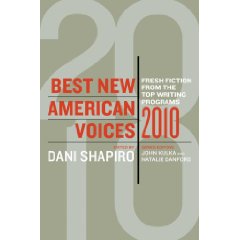
For the past ten years creative writing programs have submitted the best to come out of their programs to be published in the “Best New American Voices” series each year. This year’s edition was edited by memoirist and novelist Dani Shapiro.
2010’s edition of Best New American Voices consists of work from:
Boomer Pinches (University of Massachusetts, Amherst), David James Poissant (University of Cincinnati), Claire O’Connor (University of Idaho), Christian Moody (University of Cincinnati), Laura van den Berg (The Bread Loaf Writers’ Conference), Edward Porter (Wisconsin Institute for Creative Writing), Emily Freeman (The Loft Literary Center), Lysley Tenorio (San Jose State University), Timothy Scott (Wisconsin Institute of Creative Writing), Greg Changnon (Sirenland Writers Conference), Ted Thompson (The Bread Loaf Writers Conference), David Lombardi (University of Houston), Leslie Barnard (University of Oregon), Andrew Brininstool (University of Houston), Andrew Malan Milward (University of Iowa), Baird Harper (The School of the Art Institute of Chicago)
Unfortunately, the “best” to come out of these programs generally leave much to be desired. While all of the stories display high writing quality, the content tends to fall on the generic and dull side.
The Best of “The Best”
“Bethlehem is Full’ by Boomer Pinches
B+/A-
A young couple who have recently aborted their baby go on vacation to Australia in order to reconnect and leave the bad memories of the abortion behind them. While in Australia the narrator, the man, realizes their relationship has been forever altered in the negative by the decision they both pretended to be entirely fine with.
This story, while taking place in exotic Australia, does not lean on the many possible cliches a story based in Australia might take on, which I appreciate. The best part of this story is the couple’s relationship with a mangy dog they find on the side of the road. They both fall in love with it immediately (a possible replacement for the aborted child?) but leave it in a pound where it will be put to death in a matter of days. When the woman leaves the man to return to America, he goes back to the pound at first, we think, to save the dog. Instead he requests he be the one to put it down. It’s a shocking ending, and one that can be read into many ways.
“Horusville” by Christian Moody
B/B+
This story takes a chance on attempting magical realism- a genre of writing that, in my opinion, is very difficult to do well. Too much magic and you find up in a fantasy story, not enough and it’s just a confusing story. Moody’s story, while not perfect, does a decent job at finding the balance but not a perfect job. “Horusville” is a story about a teenage boy who lives in a town with a forest made of eyes, real watching eyes. He, and most of the townspeople, tend to do their dirtiest deeds in the forest, because everyone wants an audience. There are a lot of themes and concepts Moody could have delved into with this story but didn’t- which is unfortunate. Instead, he used the eyeball trees as more of a backdrop for a different story- one where this boy and his art teacher paint each other naked but never touch. I feel like this story was very ambitious and for that I give Moody credit, but I would like to have seen more. I think Moody is definitely a writer to watch, his writing will surely develop and grow into it’s potential.
“The Changing Station” by Edward Porter
A
This is one of those stories that so acutely zeros in on the concepts of humanity and pride. Porter’s main character, Teddy, is an older man who seems to just want to do good by those in his life, regardless of their own emotional damages. He tries to help the women in his life- his girlfriend Maria and her 17 year old daughter who is a mother, and Maria’s daughter’s girlfriend. He builds a beautiful changing station for Maria to use for her daughter’s daughter, but it is rejected. He drives the daughter’s girlfriend to the strip club she was fired from to get her last pay check. While there, the young boss refuses to give it to her and Teddy chooses to humiliate himself in order for her to get it. Porter describes this humiliation in such a way to show what it means to hold such strength while acting weak.
“Some Things I’ve Been Meaning to Ask You” by Ted Thompson
A
This is a story about a teenage boy’s regrets after the death of his father. He retells the year before his dad’s death while interjecting questions to his dead father such as, “did you know that was me?” about a school prank, and others. During that year his focus wasn’t on his dad, it was on a girl he had sex with repeatedly but wouldn’t own up to publicly. He made fun of her with his friends and then would go over to her house. In the story boy is owning up to his mistakes and regrets in such a deep way it leaves the reader feeling both disgusted with the boy and heartbroken for him. Thompson does a great job developing his teenage narrator, and his vernacular and tone use in his dialogue is spot on.
“Hero” By Leslie Bernard
A-
“Hero” is very similar to “Some Things…” in that it is about a boy who has lost one parent and uses the sex of a unpopular and generally undesirable girl to fill that hole. In this story, the boy’s mother has run off with another man, leaving his father emasculated in the boy’s eyes. He develops a friendship with a “bad girl” that skips school and sleeps with many of the boys. He has his own regrets to sift through by the end, he throws away a year’s worth of homework the girl gives to him to hand in, resulting in her not passing the grade. He also isn’t capable of having sex with her when given the opportunity, something that shames him (and, I would argue, makes him feel emasculated the way he views his dad) and he gets into a car accident, which strangely enough gets him back on the right path both with his father and the girl he decides to make it all up to. I liked this story for the same reason I liked Thompson’s- the connection they both draw between sex and parents, regrets and disappointments.
“Intermodal” by Baird Harper
A-
This story was strange for me because I am certain I have read it before, and in fact I had in an issue of Tin House. That being said, I had enjoyed the story then and I did now as well. A boy’s dead beat dad is kicked out and begins living in a storage unit. The boy keeps the secret from his mother, though it is not certain how much the mother really knows about the father. It’s a story of a boy seeing the degradation and truth about his father in a short period of time. He sees his father brutalize a man, destroy his own car, and basically allow his life to dissolve into nothing. Eventually he gets a postcard saying his storage unit was shipped away, with him in it. He receives postcards from all over, but he knows the storage unit hasn’t been shipped because he goes and sees for himself.
Some of the other stories not mentioned fell into the “B” category and had their own positive aspects, but this review would be far too long if I went over every story. So here are just the ones that really stood out.
 Bent Shelf Book Reviews