
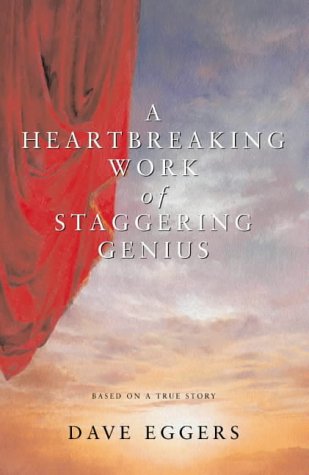
About the Author: Dave Eggers is a writer, publisher, and editor. He is the co-founder of the literacy project 826 Valencia and Might Magazine, now defunct. His first book was A Heartbreaking Work of Staggering Genius which was a finalist for the Pulitzer Prize for General Non-Fiction. He has also published multiple other books such as You Shall Know Our Velocity, The Wild Things, and a collection of short stories called How We Are Hungry. He was also a writer for Salon.com and is currently working as a screenwriter. He is also an editor and contributor to multiple other publications. He founded McSweeney’s, an independent publishing house which produces a quarterly journal among other things.
Grade:B
This semi-autobiography covers Eggers’s life, more or less, until his late twenties. He talks about his parents’ early deaths, becoming the guardian of his elementary aged brother, Toph, the dramatic tragedies of his friends, and the production of his magazine, Might Magazine.
This strange autobiography is written in a stream of consciousness-paranoid-rant style which is refreshing at first but becomes tiring frequently throughout the novel. It is interesting when he shows the reader exactly what he was thinking, nonsensical as it may be, and adds a realism to the novel that is seldom seen in other autobiographies. For instance, Eggers’ mind is constantly imagining terrible scenarios in which his younger brother, Toph, is being murdered, whenever he leaves the kid alone or with a babysitter. Its these kind of thoughts that everyone has in their day to days- paranoid concerns we know are ridiculous but can’t help but have anyway.
Unfortunately this type of writing gets old pretty quickly as the reader loses his/her patience and just wants the story to unfold. Eggers also digresses into anecdotes often, which only adds to this problem. He also repeats information and stories.
This novel would have gotten an A from me if it was maybe half its length. With the repetition cut out and the constant stream of consciousness reduced, I wouldn’t have been so frequently skimming past long passages about the hundredth way Eggers has imagined Toph being murdered by his babysitter or the lengthy descriptions of a game of Frisbee.
Eggers also plays with his characters- literally putting his words into their mouths. He writes a long dialogue between himself and Toph in which Toph psychoanalyzes Eggers in a way that is obviously above his age level. Eggers has his character Toph say what he himself is actually feeling about himself and his motives. This is often confusing but also intriguing, as I have never read anything like it before.
He also often breaks the fourth wall by having his characters get mad that their lives are being used for a book, another way in which Eggers portrays his guilt and self-deprecating tendencies.
Criticisms aside, Eggers certainly draws the reader into his erratic head with a very distinct, honest, and often self-deprecating voice. He admits, it seems, to everything. He admits he is excited about using his friend’s suicide attempts as literary fodder, and that he looks at his life as something that must be interesting enough to write about. This tactic makes him seem like the most honest narrator in the history of literature, but also completely full of crap. Which, of course, seems to be his intention. He is both completely egotistical and self-deprecating, an often funny combination.
The most interesting portions of his novel is when he paints his generation (being 20-something in the 90’s)and describes the process of producing Might Magazine.
My advice would be to read about half of this book, and then stop. It’ll have been plenty.
 Bent Shelf Book Reviews