
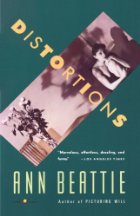
 In college I read a short story by Ann Beattie in one of those short fiction compilation books assigned in fiction classes. It was called “Janus” and I didn’t care for it.
I had no contact with Beattie’s writing until recently, when I read an interview with her in the spring issue of The Paris Review. She mentioned that “Janus” was not one of her favorite stories, which made me want to give her another chance. The interviewer and Beattie talked mostly about her older stories from the 1970’s, so I took a little walk to my local used book store and picked up a copy of Distortions, a book of her short stories published in that time.
They were…different, to say the least. Beattie uses the same recurring names in most of her stories from this time, which caused me some confusion at first thinking that these stories may be connected (they weren’t, after further reading). She used the names David and Sam the most, and in fact this book was dedicated to a David. I like to think that maybe Beattie, like myself, hates naming her characters and that’s why she reuses the same names as often as possible.
Her stories, aside from featuring similarly named characters, are all very slice-of-life pieces about normal people behaving rather oddly. Many of her characters speak very bluntly to each other of their desires and random thoughts. In “The Lifeguard” a wife tells her husband she is attracted to a lifeguard, though she doesn’t do anything about it.
Strange things like alien visitations occur (“It’s Just Another Day in Big Bear City, California”), a young man shacks up with an overweight housekeeper just so he has someone to go to the Grand Canyon with (“Hale Hardy and the Amazing Animal Woman”), and a woman has an affair while her husband keeps busy looking for fancy cooking ingredients (“The Parking Lot”). Mostly, lots of people get bored with their lives and a little crazy.
One of my favorite stories was “Wanda”, a story about a young girl whose father runs off and whose mother runs after him, to bring him back, leaving the girl with her Aunt Wanda. Her Aunt Wanda and the upstairs neighbor Mrs. Wong lecture her about men while both are very much man-less. Then her father returns and in a drunken haze kidnaps her for a “fun” weekend of partying at his girlfriend’s house.
Beattie’s stories all have similar elements and themes, showing an array of average people in strange circumstances. While some of the stories are sad, others she laces through with a subtle humor. One of my favorite passages in this collection of stories was in a story called “Vermont”, and it shows the intimate ways a couple interacts with each other:
Tonight, as I do most nights, I sleep with long johns under my nightgown. I roll over on top of Noel for more warmth and lie there, as he has said, like a dead man, like a man in the Wild West, gunned down in the dirt. Noel jokes about this. “Pow, pow,” he whispers sleepily as I lower myself on him. “Poor critter’s deader ‘n a doornail.” I lie there warming myself. What does he want with me?
“What do you want for your birthday?” I ask.
He recites a list of things he wants. He whispers: a bookcase, an aquarium, a blender to make milkshakes in.
“That sounds like what a ten-year-old would want,” I say.
He is quiet too long; I have hurt his feelings.
“Not the bookcase,” he says finally.
I love this passage because of how real it feels to me. It’s just two normal people in bed together having an unimportant conversation as they try to fall asleep that any couple could have. Beattie has such a great way with details, the way she lies on top of him for warmth and wears something as unflattering as long johns underneath her nightgown. And their short exchange struck me as hilarious, how the man decides against the bookcase of all things when she points out his wishes are childish.
I think one of the best things about Beattie’s writing is the details. She has an amazing way of writing in so many specific details that the people and places she writes about seem like they have to be real. It’s also amazing that I can read her stories now, in 2o11, that were written in the 1970s, and most of the time it felt like they could have been written recently.
I’ll admit that I’m usually one of those people who skips past the interviews in literary journals, but this Paris Review interview really caught my attention and held it. I suggest reading the interview with Beattie and if you aren’t already familiar with her work, checking out any of her short story collections or novels. She has a new compilation out now of the stories she had published in The New Yorker aptly called The New Yorker Stories.
 Bent Shelf Book Reviews
