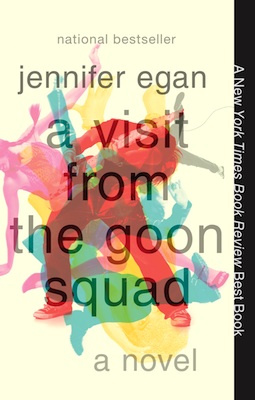
 Reading Jennifer Egan’s A Visit from the Goon Squad is kind of like going on a fantastic journey through time where you not only get to see what happens to the main characters, but also what happened to them in the past, what happens to their children, their assistant’s children, and any other random person (who, of course, is never really random) in the story.
A Visit from the Goon Squad was sitting on my shelf (I bought it after reading a review of it on TheMillions.com) when I saw that it recently had won the 2011 Pulitzer Prize in fiction.
I had purchased the novel because from what I read about it online, it was about the music scene in the San Francisco Bay Area. Having grown up in the (albeit early 2000) Bay Area music scene I was intrigued.
I was both disappointed and incredibly pleased. Egan’s version of the Bay Area music scene was not the same as my own memories of it (how could it be?) but it was also about so much more than music. For starters, most of the novel takes place in New York City, with interludes to San Francisco, Italy, and Africa. It also follows a menagerie of characters from the aged music tycoon Bennie to the young daughter of Bennie’s ex-assistant, Sasha. While I think it’s impossible to quickly summarize the plot of a novel with so many characters, I’ll attempt to do my best here:
A Visit from the Goon Squad is about people growing up.
Egan’s novel follows the lives of many characters, all intersecting at some point, but each character is only given a short amount of time in the spotlight. Bennie and Sasha are the two characters that we see the most of (Bennie and Sasha as teenagers, young adults, and adults) while many of the people they know and will know swirl around them.
After reading this novel you want to go back and read it all over again, making mental notes of each mention of each character. I often found myself recognizing names in later chapters that I was certain I had read about (usually very briefly) in earlier chapters.
At times it proves a little difficult keeping track of all the different characters, but generally Egan does a good job of keeping us in the loop. She bounces around in time as well as characters point of views, (here Bennie is a teenager in a crappy punk band, here Bennie is happily married and at the top of the music business, here Sasha is Bennie’s assistant, here Sasha is a teenager in Italy, here Bennie is tired of the music biz and divorced, etc) It’s these time changes that keep the reader so involved with the story. Each character’s lives (usually dark and full of regrets) become extremely gripping when given such extensive back story.
The only drawbacks to this novel were its last two chapters, where Egan goes a little experimental with format and jumps ahead a little too far into the future. Chapter 14, “Great Rock and Roll Pauses” is written entirely in Powerpoint slides from the point of view of Sasha’s young daughter, Alison. While I could still easily follow the story through the slides, it felt very contrived and didn’t really add anything for me. The last chapter, “Pure Language” takes place in the future, but the reader knows it can’t be too far in the future because the characters we have been following are still alive and well. Egan takes our current obsession with texting and amplifies it in this dystopia science-fiction chapter. While she maintains her way of stringing characters together, this lurch into science fiction is jolting and unbelievable. I found it hard to buy that so much had changed in such a short amount of time, although with our society’s current technological developments I suppose anything is possible. In this last chapter, Egan paints a world where everyone almost solely communicates through texting using “handsets” and where the music industry has been given a second wind through the buying powers of young children, called “pointers”. Because it is the last chapter, and rather brief, Egan doesn’t develop this futuristic world as much as it would have taken for me to buy into it.
It would be impossible for me to summarize this entire novel, or even to speak to half of its devices and motifs. It’s very complex, often depressing, but always engaging. I highly recommend it to anyone who has made a mistake or two in their lives.
 Bent Shelf Book Reviews