
*Warning: Spoilers ahead.
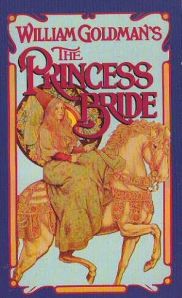 When I was about ten years old I attended a sleep over party at which I was introduced to the cinematic masterpiece The Princess Bride. Years later, the film remained on my favorite movies list. I introduced the film to as many people as I could: friends, younger siblings, even boyfriends. I still have the DVD sitting among the five other DVDs I currently own.
Needless to say, The Princess Bride had an impact on me. Now, fifteen years after being first introduced to the film, I have read the book it was based on.
William Goldman wrote The Princess Bride in 1973, claiming that it is an abridged version of a novel written by an S. Morgenstern. The book features the story (very close to the film version) and asides from Goldman himself, explaining why he cut certain sections and inserting short personal anecdotes (all of which are fictional).
In the book he mentions that his father read him the “original version” when he was a boy, and now that he has a son of his own he wanted to pass on this tradition. In reality, no such version exists, Goldman doesn’t have a son (he has two daughters), and he of course wrote the book entirely himself.
The story, if you have been living under a rock since 1973, is a fantasy about the love between Buttercup and Westely, and the trials/tribulations they must overcome to be together. If you’ve ever heard anyone say, “My name is Inigo Montoya, you killed my father, prepare to die!” you may cease your wondering: the quote is from this book.
The story is romantic, but mostly it is a comedy. The film features many of the best jokes from the book, but the book has even more comedic elements the film lacks. Goldman’s introduction and asides are incredibly witty, and I found myself more than once laughing out loud (and remember, I’ve seen the movie at least 20 times).
The book also features the back stories of Fezzik and Inigo, a welcome addition to the primary knowledge of the two lovable characters. Prince Humperdinck is also given more character development in the book, as is the relationship he has with Buttercup during Westley’s absence.
The only complaint I have of the book is the depiction of Buttercup. In the film she is certainly the dullest character, but in the book she is described as an absolute moron. Westely and Humperdinck frequently ridicule her lack of intelligence, while she herself is constantly thinking about how stupid she is. She is often described as beautiful and stupid.
I have read that Goldman wrote this story more or less for his daughters (who, it is said, asked for a story about a “bride” and a “princess”). I would think a man writing for his daughters might give them a female character to aspire to, not one to be mocked. That said, his male characters (ALL of the other characters, apart from a witch and the King’s wife, neither of which have much page-time) are very engaging.
Fans of the film won’t be disappointed by the book, and if you have never seen the movie I recommend both highly.
 Bent Shelf Book Reviews
