
-
Who do you write like?
If you ever wanted to input some text and get a quick, computer-generated response telling you which famous author you write like, well have I got a site for you!
This random site, whose sole purpose is to tell you who you write like, is incredibly stupid, but I bet you try it anyway. I put in two portions of two different stories I have written in the past and it shot out Stephen King and David Foster Wallace. When I typed in a bunch on nonsensical rambling I got Cory Doctorow, someone I have never heard of before.
There’s ten minutes I’ll never get back.
Go ahead, try it out. You know you want to.
-
Literary Journals Are Still Really Cool
Yesterday I met my friend Myron outside a Barnes & Noble. I was holding a heavy bag of $45 worth of literary journals and magazines. I had originally gone into the store simply to write down a list of literary journals on sale for later research. While scribbling names onto yellow post it notes (I never go anywhere without a thick pad of post it notes, they are a big part of my organization system) I couldn’t help but be wooed by the evocative titles and eye-catching cover art.
I flipped through about half of the journals on the shelves, sometimes murmuring happily to myself about the writers and art included, sometimes grimacing at the poor layouts. Eventually I forced myself away from the section with two journals in my hands, the summer-fall issue of Golden Handcuffs Review and the fall issue of Willow Springs, both based in Seattle, WA.
Why was it impossible for me to put these two down?
First, the size. A literary journal should be about 10.5 x 7 in. Many journals experiment with size, and almost always to the detriment of the inside layout. They have a tendency to go bigger or wider, and this seems to cause designers to want to fill the extra space by stretching the text across the longer width, which is difficult to read and causes eye strain. The first rule of design is to make it reader-friendly. The abnormal size may draw attention on the shelf, but once opened no one will want to read it.
Second, cover art.
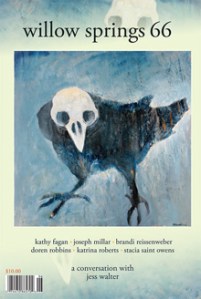 Willow Springs’s cover art is a little on the grim side, which isn’t what usually attracts me. But I have recently been looking into ornithology and have always had a fascination with birds. What I really liked about this cover, though, was the paper it used. I’m not an expert on paper types, but it had a softer, ridged feel to it which appealed to me.
 The cover for the issue of Golden Handcuffs Review I bought isn’t available online yet, but it’s a glossy white cover with a black framed b/w photo of dollhouse furniture. It has a much more professional, cleaner feel to it than Willow Springs’s.
Why does any cover art appeal to anyone? It really depends on your personal aesthetics, but most successful covers will have an image on the cover that asks a question. The only way to answer that question is to look inside.
In addition to the two literary journals I picked up a copy of Poets & Writers, which seems geared towards a much younger demographic these days than it did when I read it in high school. I also picked up a copy of The Atlantic.
After telling Myron about my purchases, he lightly criticized me for spending my money at the corporate bookstore instead of an independent.
“One thing I learned from my publishing program is that it doesn’t really matter where you spend your money, it still supports the publishing industry,” was my response. Although it would be great to support an independent bookstore in addition to the publishing industry.
So the next time you are at Barnes & Noble, Borders, The Strand, Powells, or Mom & Pop’s Books, check out the literary journal section and chip in the $10 for an issue of a literary journal of your choosing. You could stick to the big names like the Paris Review or try a smaller one. Either way, you will be exposed to new writers, artists, and you will help support those small presses across the U.S.
-
Howl 2.0
I saw the best minds of my generation destroyed by double shifts at diners, starving for healthcare and more than just an hourly wage plus tips,
dragging themselves home from work at dawn from another late shift at the bar, over-educated hipsters burning for a job in writing, publishing, graphic design,
whose poverty came not from their lack of effort but from a recession caused by previous generations’ need for greed,
who bared their brains to underpaid professors desperate for tenure,
who passed through universities with high grades and many extracurriculars hoping these would lead to a career,
who were expelled from school with a degree and little hope, who cowered in shared apartments angry that a roommate ate their last frozen pizza,
who got busted for comping a friends’ meal,
who ate only ramen and drank only water for the months they were unemployed, with dreams, with drinks, with a pile of lies instead of stock options,
who will die with student loan debt still stacked high against them,
who send out twenty resumes a day with no response,
who have been rejected from unpaid internships,
who quit smoking because it cost too much and drink only pbr on their own couches,
women who spent their last paycheck on the pencil skirts and heels required for job interviews, men who hang themselves in neckties for a chance at stability,
who have spent their lives building resumes, job experience, education, for a chance at living in this world, creating something or being a bank teller or personal assistant, stuck in coffee shops, french restaurants, Chipotle,
with the absolute heart of the poem of life butchered out of their own bodies.
-
Tin House, Volume 11, Number 4
 I am going to take a break from regaling you all with my experiences at NYU to talk about Tin House’s most recent summer issue.
 It’s amazing.
Feeling nostalgic for the Pacific Northwest I decided to pick up a copy of Tin House and Glimmer Train from the Union Square Barnes & Noble. Tin House did not disappoint. It’s reputation for publishing only the best writing remains intact.
My favorite piece was “Tales of Darkness and the Unknown Vol. XIV: The White Glove” by Steven Millhauser. Millhauser writes in such a beautiful, eery way that caught me and held me down for all 26 pages. It’s a quiet story at first, with its focus on a boy and his infatuation with a girl and her perfect family. But slowly his perfect relationship turns sour when the girl begins to wear a mysterious white glove she never takes off. A source of much embarrassment for her, she forbids him to see what is underneath.
As I was reading it I was reminded of a children’s horror story I read once when I was a kid. It was a story about a girl with a ribbon around her neck she never took off until the day she died, and her husband finally saw that it was holding her head on. That story really struck me when I was a kid, and this story affected me much the same way. Nothing really happens, and yet everything does at the same time. It’s part coming-of-age, part mystery, part horror story, but all beautiful.
The glove lay motionless. It seemed to be holding its breath. In the darkness made less dark by the blurry bar of light, I could see the two buttons at the wrist. I realized there were three of us in the room: the glove, Emily, and me.
Millhauser won the Pulitzer Prize for Fiction in 1997 for his novel Martin Dressler and has put out a few short fiction collections. I have never heard of him until now, and I feel very compelled to buy one his collections.
The other major highlight for me was the poem “Spoiler Alert” by Boomer Pinches. Here are the lines that caught my attention:
Gently I explain that I would like to be intensely remembered
By as many people as possible. This is a life
Lesson and I am some underpaid substitute teacher.
Perhaps it is because I am an existentialist ex-substitute teacher that it caught my eye. People have worse reasons for liking something. Pinches also wrote a story called “Bethlehem is Full” which was published in 2010’s edition of Best New American Voices. I mentioned liking it in a past post, this second piece has made me think I should read more from him.
Now that I have finished this issue of Tin House, it’s time to read the summer issue of Glimmer Train.
-
Olive Kitteridge by Elizabeth Strout
I chose to read this book because I had the idea that I wanted to read a book that had won the most recent Pulitzer Prize. At the time, the most recent was 2009’s fiction winner Olive Kitteridge. I wanted to see what was considered great fiction these days.
When I first cracked open the novel my firs
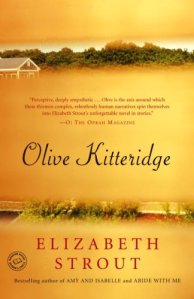 t thought was, “Oh, no, this is going to be a very boring book.’
And now, having just finished it, I wish it had never ended.
Strout uses a collection of short stories all set in the small town of Crosby, Maine centered around a woman named Olive Kitteridge. The stories take on alternating points of view, and often Olive is merely walking past the narrator for a second. It’s in this way that we receive varying opinions and memories of Olive, while also receiving a whole other world and narrative. We learn not only about Olive and various other townspeople, but about the town itself.
The novel not only jumps narrators, but it jumps through time as well. While we aren’t given a from childhood to death timeline of any of the characters, we are still given a view of how they grow over a span of ten, fifteen, twenty years.
Olive is a surly no-nonsense retired school teacher with a steadfast and doting husband whom she loves but takes for granted. We see them interact with each other and their son, Christopher, while never being capable of really picking sides when they have conflict. Strout beautifully weaves the stories so that each character is entirely sympathetic regardless of their personality faults or mistakes.
While not focused on Olive, we learn of a young girl dying of anorexia, a lounge piano singer, and many others. Certain places, like a doughnut shop, surface as settings in many of the stories.
Details aside, I can say that this novel is a story about what it is to get old- what it is to lose loved ones and to gain perspectives on life and love. The amount of love and tenderness in this novel is so natural and touching, not cheesy and cliché as some novels often are.
Some of the characters are more distinct than others which sometimes come across a little washed out, or too similar to another character. Also most of the chapters re-set scene and history too much because Strout, I’m sure, wrote it so that the stories could be easily separated. While I understand that tactic it makes it slightly annoying. I was often thinking, “yeah, I know all this already I’ve been reading the novel!”
But that’s easy to get around as she doesn’t over do it too much.
All in all, it was a very touching read with a lot of sadness. Though it has its down moments, I finished the novel feeling hopeful, not morose.
-
Review: The Wind Up Girl by Paolo Bacigalupi
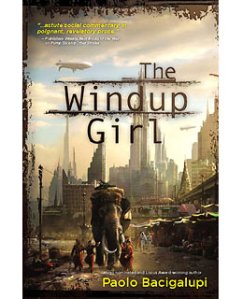 This book took me longer to read than most (and longer to write a review about, too). I decided to read this book mostly due to the title and cover art. Yeah, yeah don’t judge a book by its cover, whatever. I often buy books simply because I am attracted to its cover. Sue me. More often than not this way of choosing my reading material has worked out for the best.
The Wind Up Girl is a postapocalyptic science fiction novel set in Bangkok based in a future ridden with “blister rust” and various illnesses causing horrific deaths. Majority of the world’s problems have to do with food supply. Some evil western companies genetically produced produce-killing something or other and then also genetically produced produce/grains that are immune to the something or other that kills the produce. I think.
This leads me to my major issue with this novel: Bacigalupi simply drops the reader into an unfamiliar world using unfamiliar terms without properly explaining much. It takes about half the novel for the reader to figure out pretty basic setting stuff. I like a novel that doesn’t overly explain- giving the reader a little credit. This one however just caused me confusion. There are just too many things talked about but never explained. Like what a “calorie company” is. Calorie companies are discussed throughout the entire book and has an important part of the world’s history and main characters and yet you never get a clear explanation as to what a calorie company is.
After navigating through content that is difficult to understand (and therefore difficult to really get into) you’re left with alternating p.o.v.s between the five main characters. We have Jaidee, a moralistic white shirt rebel-with-a-cause type fighting “the man” for the common good, his second-in-command Kanya who we don’t get to know much about until the end, Hock Seng, a chinese man who lost everything and is desperately trying to figure out a way to build up his lost fortune, Emiko, a “New Person”, a part human part robot thing who has been sold into prostitution, and Anderson, a calorie man trying to find Thailand’s seed bank without ruffling too many feathers.
I really liked the use of so many different main characters. The ways in which they affect each other and interact with each other is really interesting and keeps the story moving along even when the reader has the answer to one of the character’s questions long before he/she does. The characters save this novel, but I wanted more. I wanted more back story, more explanation, more motive. The reader is given a pass into each of their minds but it always seems like you’re just barely skimming the surface.
There are some really cool details, like genetically modified super cats and guns made with springs.
All in all, I think it was a very interesting novel with great concepts, but not enough clarifying and explanation. My main feeling after reading it was that it needed a good clean up (it also is riddled with typos). I also wanted more about the wind up girl, more about her history and creation. It really could have been an amazing work with some better editing, but it was still pretty good anyway.
The next book I will review is Elizabeth Strout’s Olive Kitteridge. It will probably be the last book review I write for a while as I will be pretty busy at NYU for the next six weeks.
-
Six word memoirs
Everyone has a story. What’s yours?
For those of you who love twitter, facebook, and any other online medium where you get to say something but the amount of words allowed for you to say that something is limited, there is Smith Magazine.
It is the home of the 6 word memoir, where you may enter your own directly onto the site for free to join the many, many others. Not a fan of summing up your life in 6 words?
What about 6 words on food?
on love?
America?
There are many options available to you on the website, if you can keep it at six words.
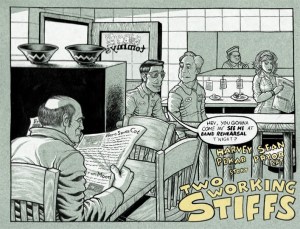 But Smith Magazine offers so much more. Book blogs, webcomics, a collection of six word memoir books for sale (think: Chicken Soup for the teenage soul, housewife soul, gardener’s soul…) and even a space just for teens. As if anyone cares about teens.
It is my official favorite online magazine of the week. Sign up, and begin posting all your six-worded thoughts. They also sell tee-shirts!
-
Crow Toes Quarterly: a really cool children's lit mag

Crow Toes Quarterly publishes submitted work that falls underneath the “dark” children’s lit section. It’s located in Canada, but don’t let that scare you away.
It’s a relatively young publication, having published only thirteen issues to date, but I think it’s a really great concept, and if I had children I would subscribe to it immediately. I might anyway.
Their submission guidelines follows, for you aspiring young adult writers:
Crow Toes Quarterly is looking for playfully dark, intelligent, descriptive literature written for children ages 9 and up. Stories can range in length, but must not exceed 3000 words and please, pretty please, send only your best, most carefully edited work. Poetry is open to interpretation…
Another guideline mentioned is that all submissions must be sent via snail mail, which is refreshing in a way, even if it seems time and money consuming.
They are also currently holding a poetry contest, write a 14 word poem about wings and submit it via e-mail. 10 winners will have their poems published and receive a free print copy of the issue in which they are published (the upcoming 14th issue). No riches or much glitz, but it’s a small publication. Submit for the fun of it.
-
I Love New York (Magazine)
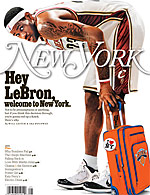 Aside from my pre-teen obsession with reading Seventeen, Teen Vogue, and the other fashion magazines geared towards educating young girls on makeup tips and “What kind of a kisser are you?” I have not been much of a magazine person.
The cost of $4-$5 for a magazine that is 90% ads has been a reason. The obsession with buying things and attempting to look like models another. Magazines, in general, never did much for my self-esteem. So I dropped them entirely sometime in high school.
There are many types of magazines, you may say, geared towards people with a plethora of interests. True. I found fault with all of them.
I found Harper’s and The New Yorker to be boring. All fashion magazines were out (the price tags on the merchandise inside are always way over my limits, in addition to the aforementioned reasons), I liked a rag called AdBusters for a while in college, but it was costly and the articles never really grabbed my interest for long.
I was always looking for that perfect magazine. The shiny, creative layouts matched with interesting essays and a dash of girly stuff. Interestingly enough, Good Housekeeping was the only one that came close. (What can I say, I’m an old lady stuck in a 24-year-old’s body).
But now, during my obsessive researching of New York City, I’ve come across New York Magazine, a magazine I have never picked up before as I have never lived in New York and figured it was something out my interest zone.
I haven’t actually read the magazine. I’ve read the website, which is amazing, especially for me at this time of my life. They have a really useful neighborhood guide for people trying to figure out the best place to move, with news and feature stories, fashion stuff, restaurant and bar reviews, a book section with interviews and reviews (They have a great review list of spring fiction books worth getting), funny blogs, the list goes on. NY Mag is awesome.
If I weren’t moving out my apartment in four weeks and unsure what my next semi-permanent address will be, I would subscribe to the actual glossy.
-
Pretty Book Art
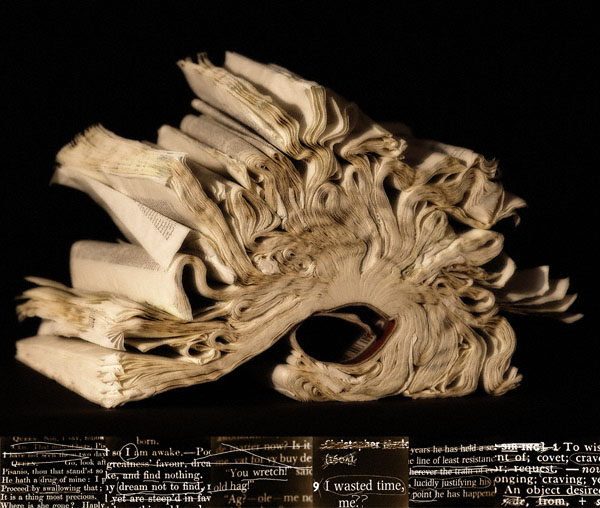
While looking through other blogs, I came upon this post from youngpublisherstoday about a photographer/artist Cara Barer and the amazing art she does.
My photographs are primarily a documentation of a physical evolution. I have changed a common object into sculpture in a state of flux. The way we choose to research and find information is also in an evolution. I hope to raise questions about these changes, the ephemeral and fragile nature in which we now obtain knowledge, and the future of books.
– Excerpt from Barer’s statement on her artwork.
Her work is pretty interesting, here are a few of the ones that caught my eye:
“Winston’s 2004”, 2004-2005 collection

“Snow 2007”, 2006-2007 collection

“Vortex 2008”, 2008-2009 collection
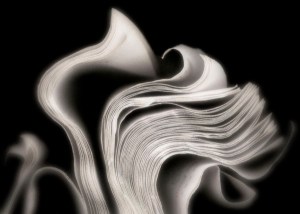
“Wave and Fog”, 2006-2007 collection





 Bent Shelf Book Reviews