
-
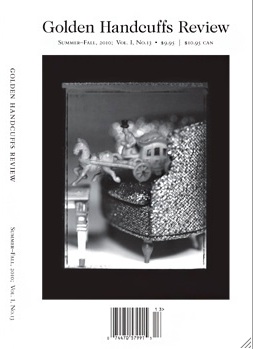
Golden Handcuff Review
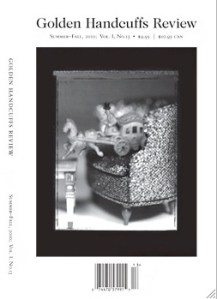
This issue of Golden Handcuffs Review featured writing from Leslie Kaplan, Augustus Young, Pierre Senges, Ken Edwards, Francesca Duranti, Joseph Donahue, Matt Briggs, Toby Olson, David Antin, Victor Hugo, Charles Baudelaire, Jani Macarty, Peter Quatermain, Meredith Quatermain, Susan Smith Nash, Leonard Schwartz, Tyrone Williams, and A D Jameson.
I picked this issue up at a Barnes & Noble in New York City. It’s sleek shiny cover and interesting black and white photography drew me in. I read it mostly while laying in bed, though at one point I read it while sitting on my boyfriend’s parent’s deck drinking a beer and every so often admiring the view of the Ruby Mountains.
Of the 154 pages, I only got to page 115, at which point I gave up in frustration. Each story was just so extremely uninteresting, unengaging, and even rather irritating. Many of the authors were playing with form, some with extremely long run-on sentences, others with numbered paragraph segments, and even the use of random spaces between words. None of these literary “innovations” added anything to the works and mostly just made them difficult to read. I am always open to new ways of writing, but only if the plot warrants it or if it is done in a successful way. I did not see much success within the pages of this literary review.
I often had to force myself to finish a story, and sometimes wasn’t able to force myself to finish. The only story I enjoyed was Francesca Duranti’s fiction piece, “On the Opposite Side” which told a brief history of a writer’s life and how she got to where she was. It followed her from divorce to a trip to Singapore, describing how she came to stand on her own two feet and write. I’m sure this story could be compared with the hideous Eat, Pray, Love by Elizabeth Gilbert, but this was just a few pages long and seems to me to be far more interesting than Gilbert’s life.
I had a lot of free time, so I would cut and sew beautiful coloured kimonos, I would paint birds, I would bake special corn cookies from my Piedmontese grandmother’s recipe-book. Riccardo wore my kimonos, admired my paintings, devoured my cookies. Then, more or less in the same spirit, I wrote a novel. But this time, without trying to explain it to myself rationally, I felt I felt it was different. So I didn’t tell Riccardo, and I didn’t inform him that I sent the manuscript to a publisher. But then I had to tell him that it had been accepted and that it was going to be published. So he walked out on me. For good, forever. -Excerpt from “On the Opposite Side”
I had high hopes for this review, and I was very disappointed. I did love Joyce Ravid’s photography, however. They were cute yet strangely creepy black and white photos of miniature furniture.
I would not buy another copy of this review in the future. I did not feel engaged by the majority of the writing selected and I just think there are too many great things to read out there without wasting my time on this.
-
Top Ten Popular Books I Never Want To Read
Or, Top Ten Reasons The New York Times Best Sellers List Is A Bad Place To Go For Recommendations
10. Angelina by Andrew Morton
It’s not that I have anything against the plush-lipped, child collecting actress. It’s that I have something against celebrity biographies in general. It’s one thing if the celeb wrote a memoir, it’s another for someone to compile information on a celebrity in order to make a buck. I also don’t have any interest in Angelina’s life. It may be great reading material, I don’t know, but I just don’t care.
9. Lego Star Wars by Simon Beecroft
Lego Star Wars (an annotated visual dictionary) has been on the best sellers list for 34 weeks and is currently at #1. What can I say, kids really really love legos and star wars. I, however, don’t.
8. My Horizontal Life and Are You There, Vodka? It’s Me, Chelsea by Chelsea Handler
As I have already read her book Chelsea Chelsea Bang Bang and was not impressed (read my review here) I have no interest in reading her other books. But other people do. You would think after reading one people would get the jist of Handler’s life and sense of humor and not feel the need for more. But all three of her books have spent serious time on the New York Times Best Seller list so it leaves me baffled. How much can one person read about Handler’s loser father and her own drug and alcohol abuse? It gets old fast, in my opinion.
7. The Secret by Rhonda Byrne
This book was made into a popular movie, a self-help concept that derives from a “ask, believe, receive” way of thinking. Wow. really? Just ask, believe, and then I will receive? This is really stupid on two levels. One, just asking for a pink elephant and believing I’ll get one isn’t going to get me my elephant. Two, if I want a job, I of course will apply for it (ask?), then I can sit at home thinking really hard “I will get this job because I applied, I will get this job because I applied” (believe?) and then blammo! Instant job! (receive?) well I can tell you from first hand experience that this method did not work. It didn’t work for the 27 jobs I have applied for in the past month. Maybe I just wasn’t believing hard enough. Or maybe the world doesn’t run on wishes and moonbeams.
6. Heat Wave by “Richard Castle”
I love the television show “Castle”. I adore Nathan Fillion. I mean ADORE. I loved him as the big baddy in Buffy the Vampire Slayer, I fell madly in love with him as Captain Malcolm Reynolds on Firefly, and even liked him as Captain Hammer in the short Dr. Horrible’s Sing-Along Blog. You could say I’m a big fan. But that doesn’t mean they (the evil “they”, “they” who take a good thing and make it weird for no reason) can take a FICTIONAL character from a t.v. show and PRETEND he’s real by publishing books under the FICTIONAL CHARACTER’S name. It’s just stupid.
5. I Hope They Serve Beer In Hell by Tucker Max
This one came out a while ago, but is still raking in the dough for some reason. I don’t have any desire to read about a “self-absorbed, drunken womanizer” (NY Times.com) . If I want to hear about one of those there are plenty of bars with Tucker Max look-alikes just dying to tell me all about themselves. I just don’t support making a celebrity out of a run-of-the-mill ass.
4. ___ My Dad Says by Justin Halpern
I read books because they offer me something the internet and television cannot: a world made partly by an author and partly by my imagination. Something that will entertain, provoke ideas or thoughts, or provide me with knowledge I no longer had. I do not buy books in order to have a compilation of tweets in paper format. No thanks. (read full essay on why I hate this book on Thursday!) Also, we’re all grown ups. Just say “shit”.
3. Eat, Pray, Love by Elizabeth Gilbert
This popular book has recently been made even more popular by the recent movie starring the lovable and cuddly Julia Roberts. I just don’t like anything that is described as a “search for self”. You are not going to “find yourself” traveling to a bunch of countries. You’re not going to be examining a fancy rug or porcelain elephant hand crafted by poverty-stricken children and suddenly find yourself among the knick-knacks. Travel is fun, travel provides experiences that become a very tiny aspect of who you are, but it doesn’t provide a whole new self. Why was this book so popular? Because there are a lot of miserable people (women) out there that feel stuck in loveless marriages and are forced to live vicariously through someone who can afford to travel the world on a book advance.
2. The Twilight Series by Stephanie Meyer
I just don’t want to hear about it anymore. I saw the first movie, it was really boring. The books do not interest me, either. Did you know that the number of babies named Edward and Bella shot up after the popularity of the Twilight series? That’s right. Thousands of idiot parents are cursing their newborn children with names from a sparkly vampire series. Poor kids.
1. Everything by Nicholas Sparks
I respect the man. He keeps churning out cheesy tear-jerkers and Hollywood keeps making them into movies. Good for him, he’s found a profitable niche market and is utilizing it beautifully for his own financial gain. At least someone in publishing is making money. But I refuse to sit at home, alone, weeping over lost love or lost lives wondering why MY ex-boyfriends don’t wait years and then pop out of the woodwork to profess their undying love for me. Pass.
-
FFF: The Ocean
Here are the results from last week’s prompt. As this is the very first Flash Fiction Friday prompt, I decided to post all of the submissions I received.
I knew a girl whose brother had drowned. Not on this beach, but on another one probably exactly like it. I thought of him as I paced leisurely–too leisurely, really–down the bank of the disinterested ocean, waves lapping hard at rocks somewhere down the coast. People stroll down the beach, people scowl at seagulls, people drown. I was never friends with her, though she perhaps thought of me as one, our mutual awkwardness and bad skin binding us together like cousins. When he died, she flew back into town and called me. I met her at a suburban coffee shop on a Tuesday afternoon, enormous faux-Italian vases bookending our table. She told me about her life since high school, gesticulating with her slender hands, which were tipped with long, untended and slightly yellowed nails. Up and down her hands and arms, clusters of warts fought for space. I felt pity, and empath really, listening to her talk about her askew life, feeling a little strange every time she used the phrase “baby brother.” I felt bad, but I also felt angry. I felt an urge to clean her up, buy her conditioner, replace her flared pants with a smart pair of dark-wash jeans. “We are supposed to get better,” I wanted to yell at her. “We are supposed to buffer our edges and prove everyone wrong.”
–“Alisha”, Nataliya Pirumova, Portland, OR
Steven listens to the waves fall on shore like the sound of feet slapping against asphalt, and to the water run out over the rocks and sand back to sea like the sharp intake of a runner’s breath. He wonders how long this will continue — the relation of every experience to being on the lamb. A fugitive’s mentality. Probably until he is behind bars. For the past two weeks it’s been like this, westward motion in a zigzag across the countries forgotten roads, doing anything to anyone just to get away. Steven went west because it was the only direction to go away from Plainview, New Jersey, where he’d left three dead in a liquor store robbery. He’d shot his way across the breadbasket states. Burned rubber through the Wyoming, Utah, Nevada deserts. Finally, this morning, as the sun blinded him in the rearview mirrors, he’d made his way into California. In a way, California had always been a promised land, a place in stories where people could abandon their miserable lives for success, freedom, a new life. But Steven doesn’t feel any different as he sits in the crusted sand. Even at high noon, the air is cold, the water colder. He listens and he hears sirens, faintly, in the distance from the east. -“Fugitive”, James Grange, Spring Creek NV
“I canned it.” He said, looking out at the sea.
“What do you mean?” The little girl said, without taking her eyes off what was in her daddy’s hands. “I thought only fish came in cans.”
She thought of the tasty canned-fish sandwiches her mother made for her. Her mother would make them and then take the crusts off with a big knife, cut it in four—and throw them out the window, onto the deck. Then she would eat the crustless, and quartered sandwich while watching the seagulls feed.
“No, not just fish. Almost anything. It’s a way of saving. That what I was doing. Saving this for when we don’t have it anymore.”
“Don’t have any what?”
“Any ocean.”
“Is it going away?”
“No. We are. We’re going away from here, into the land. We won’t hear it anymore.” He looked again, out at the sea.
“Will the birds still eat my sandwich crusts?” This seemed important to her, more important than the ocean. She pictured herself watching them lie there while she ate. She pictured uneaten crusts in piles, and she pictured her father,finally, pushing them away with a big broom.
“Maybe the raccoons will eat them…” He said.
-“Inland”, Isaac Mayo, Portland, OR
she pulled out her dick and took a long, contemplative piss into the great pacific, turning it a bit more yellow than the gold of the sunset conspired. it had been a long day, and bucked the recent trend of feeling like a mute hourglass, sand bleeding out like the proverbial hole in the dike. time rushed callously on, and she awkwardly shivered through the nights like a little dutch boy with cold fingers. this, compounded by fear that everyday day was slightly shorter and less remarkable than the last, had really put a kink in her bladder, so to speak. thus, overlooking the grandeur of the moment, mingling salt with salt, giving the balls a scratch, really stoked the fires of friday night ambition. with a flip of the wrist, shaking the last few drops, she packed it up, lit up a smoke, and turned her back on the sparks playing in the flotsam. driving back, driving fast, the radio was an oracle. all the songs were about summer nights, all the women were beautiful, and everyone got their rocks off. and, as she lit up another, she knew tonight she would be no exception. -Madeline Enos, Coos Bay, OR
Swish, swoosh, crash. The ocean was a puppy licking his feet An ice cold puppy that sounded like a toilet flushing. It was one of the sounds that brought him back to childhood. His feet sank into the wet sand. He wondered if the beach was still populated with the same sand from his childhood. The sand he had built his countless castles out of. Or was it like everything else in his past, gone, dispersed, scattered over a thousand miles by time and lunar cycles and other geophysical phenomena that rule the heavens?
He had built them like a zealous little Templar conquering the holy land. Every night, under cover of darkness, driven by the influence of the golden crescent, the tide would reclaim them like a horde of angry Saracens. Beneath the slurping and the splashing he heard the cacophony of seagulls. Beneath the shrieks and cries of birds he heard laughing, soft and silly. He opened his eyes and saw the carefree young knights, on the road to Jerusalem, armed with buckets and spades, starting a new crusade. Swish, swoosh, crash.
-“The Road to Jerusalem”, Dan Adler, Portland, OR
Here’s my own (exactly) 200 word flash fiction piece. My creative writing skills are a little rusty, so hopefully these weekly prompts will assist me in getting back my groove.
It’d been years since she’d seen the ocean. Megan had loved it once, the hiss and crash of the waves, the way the salt in the air clung to her skin. She had often spent time sitting in the sand and watching seagulls scream at each other before the hard ocean winds threw them hard against the cliffs. They’d fall in a jumble of broken wings to the beach below, where sand mites and other scavengers would pick at their bones. She would try to bury them, sometimes. But Megan learned that the wind, the waves, and small children would quickly unearth them. She knew she would have to dig deeper, deep enough so nothing would disturb their rest. It took her a month of digging before she reached a depth suitable enough for her needs. She dug in places where the sand was damp, so it wouldn’t continually spill forward into the hole. The place was set back from the shoreline, deep in the brush where a creek ran towards the ocean from the mainland. But by the time she had dug as deep as she wanted to go, it was no longer seagulls she planned to bury there.
-
First Flash Fiction Friday Writing Prompt
Write a flash fiction piece of 200 words or less based on the prompt, email it to laurareviewsbooks@gmail.com by Sunday at 6 p.m. I will post my own piece and my favorite three on Monday. At the end of each month, my favorite flash fiction writer will be mailed a free book. Questions? Leave a comment.
In honor of my visit to my coastal hometown, I thought this would be a good way to start out Flash Fiction Fridays. Watch the video, send me your flash fiction.
-
Change is in the air, better get your buckets
I’ve decided to make a few changes here at Laura Reviews Books. Book reviews will take on a different format, and I will be posting Monday-Friday on this schedule:
Mondays: Flash Fiction Friday Winners
Tuesday: Top Ten Tuesdays
Wednesday: Book Reviews
Thursday: Op-Ed piece on publishing news or other related topic
Friday: Flash Fiction Friday Writing Prompts
Considering my readership isn’t very high, I’m not certain this will be a lasting feature but I thought I would give it a try. If it fails miserably, I will come up with something else for Fridays. The concept is this: I will post a new writing prompt every friday and I will ask readers to write a 100-200 word flash fiction piece based off of it. I will write my own, as well. Email them to laurareviewsbooks@gmail.com and I will pick the best ones to post on Monday along with what I come up with. I will post your name and link to your site if you so wish. At the end of every month (beginning September) I will pick one flash fiction winner and mail them a book, it will most likely be one that I have reviewed for this site. Send pieces by Sunday 6p.m. PST.
This schedule will begin Monday, August 23. Flash Fiction Fridays begins this Friday.
-
Postcards from a Dead Girl by Kirk Farber
 Postcards from a Dead Girl is the story of Sid, an incredibly troubled young man still coping with the death of his mother (whose ghost lives in a bottle of 1967 Bordeaux) and is assaulted with postcards from a dead (not dead?) old girlfriend named Zoe.
The novel follows him to his job as a telemarketer for vacation packages, to his multiple hospital visits for real (and imaginary) ailments, to his penchant for mud baths and car washes, and through his many failures in life and love.
The narrative is very fractured, with his chronological day-to-day life interrupted by memory and dream chapters. These memory chapters slowly give the reader answers to some of the questions posed (how did the mother die? what happened to Zoe?) but only after reading almost half the novel.
I really enjoyed the tone of the novel. Sid’s first person voice is casual and unpretentious. It’s the voice of any number of down and out twenty-something guys trying to cope with their issues. I also really liked the short chapters, most were only two to four pages long, allowing the novel to be read very quickly.
What I didn’t really enjoy was how nothing much happened during the novel. Sid goes to his crappy job, screws up with women we don’t care about, talks to his dog Zero and his friend the postman, and argues with his doctor sister. At the start of the novel I had thought it would be a semi-mystery, following Sid as he tries to solve the case of the dead girl postcards. But it doesn’t really go that direction.
Postcards is a light, semi-entertaining read one could eat through in an afternoon if so inclined.
-
Willow Springs Issue 66
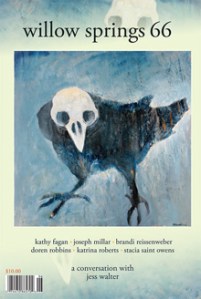 This is the first issue of this literary review I have ever read, so it’s difficult to give a full review of a journal having only read one issue. This may be the best, or worst, issue Willow Springs has ever put out, and I would have no idea.
 That said, I was surprised by the amount of poetry included in this review. Most literary journals (in my experience) are usually made up of mostly short fiction with a small spattering of poetry. This was primarily poetry.
Now, I used to love poetry. I fell in love with Michael Ondaatje’s The Cinnamon Peeler and Lawrence Ferlinghetti’s A Coney Island of the Mind. In recent years, however, I have not been introduced to much contemporary poetry I liked. Poetry makes me uncomfortable- the really awful poetry is easy to spot- basic rhyme schemes or an attempt at Old English style poetry is always wince-worthy. Great poetry, I feel, is almost impossible to spot due to how subjective it is. That said, I don’t know what to say about the various poems included in this issue of Willow Springs. None of them spoke to me. None of them grabbed me by the heartstrings or the brainstrings or any other bodily strings. I would say they were mediocre. I would also say I have no idea what half of them were about.
Poetry either speaks to you or it doesn’t. I can say they were pretty well written, and I’m sure someone somewhere will be moved by one, if not all, of them. I just wasn’t.
The short fiction, however, was really great. Kerry Muir’s The Bridge was a beautiful snapshot of childhood in the early 1970’s San Francisco Bay Area. Two young girls are forced to play together one day, and through their eyes we’re given a brief view of the adults in their lives and the experiences that will shape who they become. Muir really brought me in to the setting quickly and with ease, I felt very immersed in their location and time.
Stacia Saint Owens’s “Color by Numbers” was the winner of the Willow Springs Fiction Prize. Owens played with form by telling the two stories of a boy and girl switched at birth in horizontal columns next to each other on the page. Portions that weren’t about the children directly were in long paragraph format with no indentation. This unique formatting was a little difficult to read (the girl’s story would continue to the next page while the boy’s would stop, or both would continue to the next page and it was hard to choose whose story to read first) but did create a very different reading experience. I felt as though their stories were occurring simultaneously by putting them next to each other like that.
The storyline was interesting as well. A boy and girl baby are switched at the hospital by accident, and we are shown how they develop in their false families and how one parent’s personality trait could have helped his/her biological child but instead was harmful to their supposed child. The story follows the boy and girl through to the end of their lives.
I have undertaken the mission to find one or two literary reviews I really like and then to follow them through subscriptions. Tin House is on my short list, but I don’t know if Willow Springs will make the cut.
-
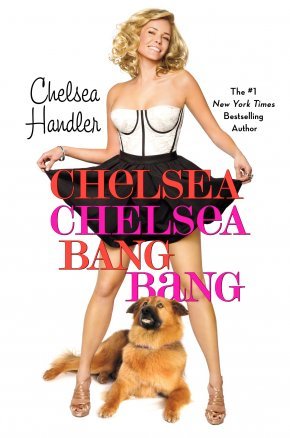
Chelsea Chelsea Bang Bang by Chelsea Handler
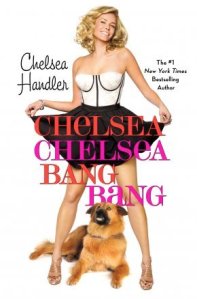 I want to begin this review by stating that I would never have read this book if it hadn’t 1) been given to me for free, and 2) cracked up my roommates who also got it for free.
 Chelsea Handler is a stand up comedian with her own t.v. show called Chelsea Lately on E! and author of two other best-selling books, Are You There, Vodka? It’s Me, Chelsea and My Horizontal Life, neither of which I have read nor do I plan on reading. She is also a guest columnist for Cosmopolitan magazine.
I watched a few clips of her stand up before cracking open her book and thought she was pretty funny. Not rolling in the aisles, posting links on my facebook page funny, but still funny.
Her book was not what I had expected. It held a few laugh-out-loud moments, but was mostly long anecdotes that I’m sure were funny at the time, if you were there, if you were Chelsea Handler. In my opinion, reading about her obsession with childhood masturbation and a whole chapter about watching t.v. and eating Lean Pockets did not strike me as hilarious. It was actually really boring.
It was time for another Lean Pocket. Even though I’m leery of any food item that is not an actual burger but claims to have a burger in it, I knew that these weren’t normal circumstances, and I opted for the cheeseburger Lean Pocket. I thought about taking a look outside but didn’t want to upset myself further with the sunlight. “It’s best to get back to your area,” I said with a little disdain , and then noticed a houseplant that needed a trim.
The book is a compilation of anecdotes, some from her depressing childhood and others from her self-obsessed adulthood. She paints herself as an immature, childish, “useless” person that requires an assistant and boyfriend to take care of her. I realize that a lot of people find her to be funny, and probably enjoyed this book immensely, but it just annoyed me. Almost everything she wrote about made me concerned for her well-being, which is not something I usually feel for authors. And it’s definitely not what I want to feel when reading a book that is supposed to be funny.
From her dependency on her boyfriend and assistant, to her completely incompetent father and deceased mother, to her drug and alcohol abuse and weight obsession, a rather unpleasant picture is painted of Ms. Handler. I felt uncomfortable at some points in this book and wanted to take her to detox with a side of therapy. Maybe I missed the whole joke, but it seemed underneath her self-deprecating humor there are some serious problems there.
Here is a telling interview clip with Handler talking about Chelsea Chelsea Bang Bang.
-
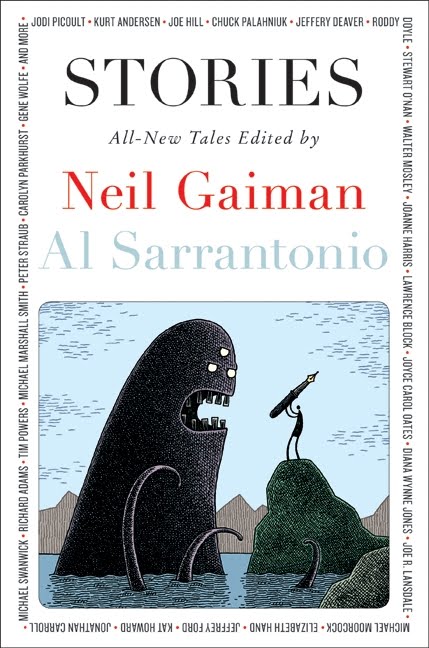
Stories: All-New Tales Edited by Neil Gaiman and Al Sarrantonio
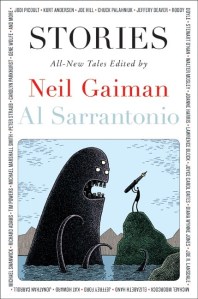 This was one of the books given out for free during my publishing program. It’s one of the few I was genuinely excited about reading (others, like Seth Grahame-Smith’s Abraham Lincoln, Vampire Hunter I gifted to my boyfriend without reading).
 But this collection of stories called to me. I have only read one of Neil Gaiman’s pieces, Coraline, and it was a long time ago (a long time before the movie came into being, I might add).
What we missed, what we wanted to read, were stories that made us care, stories that forced us to turn the page. And yes, we wanted good writing (why be satisfied with less?). But we wanted more than that. We wanted to read stories that used a lightning flash of magic as a way of showing us something we have already seen a thousand times as if we have never seen it before.
This is a quote from Neil Gaiman’s introduction to the collection. As I read through each story I found myself searching for each “flash of magic” and never had difficulty finding them. Of course, not all of the stories were great works of art. Some I had to struggle to get through because they were simply boring. One of these was Al Sarrantonio’s own story, The Cult of the Nose, which I found to be rather rambling and dull. It was a story about a guy who travels the world searching for some information on a make-believe cult of people who wear fake noses. The other was Stories by Michael Moorcock, a long narrative about a writer and other writers and how messed up they all are. It just didn’t say anything interesting and felt like he tried to combine stories of his own friends and put into a short fiction piece. This may or may not be the case, but it just didn’t fit with the rest of the stories and was boring in comparison.
There were, however, many really entertaining stories. Neil Gaiman’s The Truth Is a Cave in the Black Mountains was a tale about a man on a quest. A very, very short man, on a very, very strange quest.
Blood by Roddy Doyle and Juvenal Nyx by Walter Mosley are both vampire stories, but very different from each other and from the Twilight-type vampire. In Blood, the vampire is merely a man who wakes up one day craving blood and decided to suck on raw pork chops and steaks. Juvenal Nyx is a more traditional vampire, made by another vampire and allergic to the sunlight.
Fossil-Figures by Joyce Carol Oates is a story about twin brothers, one evil, one not evil.
Wildfire in Manhattan by Joanne Harris is a story about greek gods who come to live among us in modern-day New York City. It’s better than it sounds, I promise.
Unbelief by Michael Marshall Smith is an amusing story about an assassin whose job it is to kill Santa Claus.
The Stars Are Falling by Joe R. Lansdale is a really great story about a man who comes back from war to see his wife is not as he remembers her and their son has no interest in knowing him. After a few failed attempts at normalcy, he begins to realize what has changed.
The Knife by Richard Adams is a very short story about a boy who decides to murder the head prefect of his house.
Weights and Measures by Jodi Picoult begins, “The loudest sound in the world is the absence of a child.” The story is how a couple deals with the grief of losing their only child to illness. It begins as a typical grief story, but soon strange things begin to happen.
Goblin Lake by Michael Swanwick was a really fun story about a man who is brought to the realization that he is a character in a book. When told, he is given the choice to stay in a chapter in which he is bedding a mermaid or to go on to the next chapter where he is old, married, and living on a farm.
Mallon the Guru by Peter Straub is a rather forgettable story about a man who enters a village to meet with a spiritual guru only to be welcomed as someone with powers of healing.
Catch and Release by Lawrence Block is a disturbing story about a serial killer fisherman written from his point of view. It’s really creepy, a little gory, and a tale of caution for women who are too trusting of strange men.
Polka Dots and Moonbeams by Jeffrey Ford is a confusing story. I spent most of it grappling for some sense of stability or realization, only to be left wondering. A couple goes to a fancy (albeit scandalous) club and are almost immediately offered a deal if they murder the concierge.
Loser by Chulk Palahniuk was a disappointment. A story about a college kid on acid who becomes a participant on a game show, it is riddled with Palahniuk’s usual “material possessions are ruining our lives” message. The story acts as a brief snapshot of an hour of time from the point of view of the tripping student as he realizes he doesn’t want his life to be simply an accumulation of ground beef and sports cars. It just didn’t tell enough of a story and relied too heavily on drugs as the reason for any interesting thought or image the student has.
Samantha’s Diary by Diana Wynne Jones was an interesting tale that takes place in the future. A successful model is harassed at Christmastime by an unknown admirer who continues to send her trees, birds, and eventually nine lords a-leaping. Her Housebot continues to answer the door and accept the gifts regardless of the reprogramming and her ex-boyfriend thinks the whole thing is hilarious.
Land of the Lost by Stewart O’Nan is a story about a woman who, left alone with her dog, decides to search for the body of a murdered girl she read about in the newspaper. Her grown children think she’s losing her marbles, but everyday she sets out to find the missing girl.
Leif in the Wind by Gene Wolf was a great space story of three astronauts who finish mapping a new planet and are about to return to earth when one of them begins to act very strangely.
Unwell by Carolyn Parkhurst and Parallel Lines by Tim Powers are both stories about old sisters who have a strong love-but mostly hate-relationship. In Unwell, one sister tells how she stole her sister’s husband and plans to do the same with her new one, while Parallel Lines tells the story of a dead sister who tries to convince a young neighborhood girl to let her ghost inhabit her body. Jealous, the living sister tries to keep it from happening.
A Life in Fictions by Kat Howard is a cute story about a girl who is her boyfriend’s muse, so much so that when he writes about her she disappears into his stories- literally. As time progresses, she begins to forget who she really is and the many characters based off of her become her.
Let the Past Begin by Jonathan Carroll was a really good story that ended too soon. It has great development, a great concept, but an ending that left too much to the imagination. Let the Past Begin is a story about a pregnant young woman who tells her two lovers a story about the silent child- a child who is born half-dead and half-alive and the mother can tell the future by touching the baby. The woman, Ava, tells her lovers what the woman foretold for her, but we never find out what happens. The story ends on a cliffhanger with some questions resolved, but others left open. I would have loved to read more about the silent child and Ava’s own child, but Carroll left me hanging.
The Therapist by Jeffery Deaver is a story about a therapist who believes that nemes, negative energy clouds, are what causes people to do terrible things. He believes it is his job to help people rid themselves of nemes. He sees a woman he believes to be filled with a neme, and he takes it upon himself to cure her of it.
Human Intelligence by Kurt Andersen is a story about an alien who has been living on earth for a very long time documenting what goes on for his own planet’s records.
The Maiden Flight of McCauley’s Bellerophon by Elizabeth Hand is a really good story about a man who lost his wife to cancer, his son he can’t control, two ex-coworkers, and a strange phenomenon that happened to an aircraft in 1901. It was very engaging, and the characters really became fleshed out by the end of the story.
The Devil on the Staircase by Joe Hill defies convention by taking the format of sentence staircases to match the title and plot of the story. For example:
“I was
born in
Sulle Scale
the child of a
common bricklayer.”
The story is about an Italian boy who works hard his whole life, carrying things up and down stairs, until he does a terrible thing which leads him to meet the son of Satan.
I wanted to give you an idea of the stories included in this collection without giving away endings, so I apologize if some of them were a little vague. In general, this was a fun collection to read and it was nice to take a break from the heavier fiction and read some lighter campfire-type stories.
al sarrantonio, carolyn parkhurst, chuck palahniuk, diana wynne jones, elizabeth hand, fantasy, gene wolf, jeffrey deaver, jeffrey ford, joanne harris, jodi picoult, joe hill, joe r. lansdale, jonathan carroll, joyce carol oates, kat howard, kurt andersen, lawrence block, michael marshall smith, michael moorcock, michael swanwick, peter straub, richard adams, roddy doyle, Short Fiction, stewart o’nan, stories edited by neil gaiman, tim powers, walter mosley -
The Thieves of Manhattan by Adam Langer
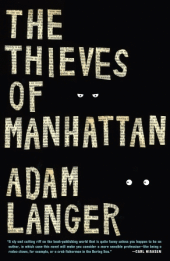
Magazines were reviewing books for issues that would be coming out six months from now, publishers were signing up manuscripts that wouldn’t be in bookstores for years. What seemed like a good idea for a book in outline form now might well be irrelevant when the Times reviewed the finished version three years later, if the Times would even review it, if the Times would even have a book review section, no sure thing given the declining circulation numbers of newspapers nationwide; if the editor of the book would even still have a job at the publisher that had employed him or her when the contract for the book had been signed- if the publisher itself hadn’t been folded into some conglomerate or been driven out of business entirely. In the past half decade, half a dozen magazines about books had launched and folded, replaced, for the most part, by book blogs, which no one knew how to make money off of.
And in one long paragraph, Adam Langer summed up about three weeks of my summer publishing program at NYU.
Langer’s The Thieves of Manhattan, published by Spiegel & Grau, is a strange novel within a memoir within a novel that may or may not be true. Our protagonist is a familiar one- struggling writer stuck at a dead-end job at a coffee shop angry at the publishing world for opting to publish big sellers with no literary merit instead of his “small, quiet” stories. The novel starts off slow, sounding like countless stories submitted to college literary magazines by struggling writers, but it takes an interesting turn about thirty pages in when our young disgruntled hero meets “the Confident Man” and his slow decline is interrupted by the Confident Man’s story, and his plan for literary revenge.
What starts out slow picks up fast and becomes difficult to put down. Everything written about the publishing industry aligns with what the professionals in the industry lectured about during my program, which gives validity to an otherwise untrustworthy narrator.
It’s a fun story with many twists and turns, adventure, treasure maps, art, love, and an insiders look at the modern-day publishing industry that will leave you wanting to smoke vonneguts while woolfing through the pages and drinking a faulkner on your proust.*
*The author uses famous author’s names in place of common words, in this case vonneguts are cigarettes, woolfing is to go through quickly, faulkner is whiskey, and a proust is a couch. A glossary is in the back for your convenience, but you really become accustomed to his usage of these terms pretty quickly.


 Bent Shelf Book Reviews