
-
The Lost Books of the Odyssey by Zachary Mason

Grade: D
About the author: This is Zachary Mason’s first novel.
This novel is a collection of alternate versions of the stories of Odysseus. He imagines new scenarios for Odysseus’s home coming, and in one story makes the claim that Penelope, Odysseus’s wife, is actually Helen of Troy. In another, Odysseus was actually a coward who escaped from the Trojan War to become a bard (Homer) and created his own heroic accomplishments from his imagination.
It reads as a collection of short stories which aren’t put in any real order. They don’t follow the timeline the original Odyssey does, and isn’t grouped by plot. Alternate versions of The Trojan War are intermixed with Odysseus’s journey to Hell and Cassandra’s tale.
I would recommend this book only to Greek mythology gurus, especially those obsessed with The Odyssey. I would not recommend the book to anyone else. I enjoyed The Odyssey when I read it in high school and was something of a Greek mythology nut myself back in the day, and I was still terribly bored for the majority of the book. Some of the stories are so vague it’s difficult to tell who the tale is about and what is going on.
Mason does mirror the style of writing in The Odyssey pretty well, with some modernization to make it more easily readable. It seems well researched (he tells stories of the major players in mythology, but also drops in some lesser known) but I wasn’t going to bother to check his facts. He adds some footnotes to help the reader along, but they are not stories within themselves or amusing, as other reviews have stated. They are simply helpful.
Some of the stories are interesting “what if” scenarios, but for the most part just doesn’t hold my interest. I give it a D for not holding my interest and for failing to be “amusing” as it was so often described.
Here is a more in-depth review, if interested: NY Times Review
-
A Common Pornography by Kevin Sampsell

About the author: Kevin Sampsell is the publisher of Future Tense Books, works at Portland, Oregon’s Powell’s Books, and has written a few collections of short stories called Creamy Bullets, Beautiful Blemish, and How to Lose Your MInd with the Lights On. He was the editor of Portland Noir and The Insomniac Reader. When I was the editor for a college literary magazine I invited him to speak at one of my events about independent publishing, so I have met with him and listened to his lecture. This is one reason I chose to read his recently published memoir.Grade: B-
When I was in college, I took a memoir writing class and received a piece of advice from my professor I completely agree with and keep in mind when I read memoir. Her advice was not to write a woe-is-me whinefest focusing soley on the bad things in your life.
Unfortunately Sampsell never had this professor. The memoir is made up mostly of bad memories about his childhood and specifically his father, interlaced with his experiences with sex and pornography. The result is a memoir that never breaks from gritty, dirty, and depressing.
The few portions about having fun with his friends playing basketball or dancing at a club aren’t enough to break through the grim storyline.I chose this book partly because I have met Kevin Sampsell, but mostly because it is a memoir written in short vignettes. Ever since reading The House on Mango Street in high school I have been enthralled with a novel told in vignette form. I have yet to read one done as beautifully as The House on Mango Street, but I am not giving up yet.
As many of the vignettes in this book were previosuly published as short stories, there are often times when it feels more like a collection of short stories than a collection of vingettes with a connecting story arc. Indeed, there isn’t much of a story arc except that it flows from his childhood to present day life.
This is the kind of collection that will inevitably spark memories from the readers. And probably not happy memories, so be prepared for a haze of gloom to appear above your head while reading this.
It was a very quick, interesting read, and Sampsell uses great details to illustrate his stories, but I am gravely disappointed in its darkness. I had expected some startling and saddening tales of childhood woe, but I had also expected some dark humour and happy highlights as well. It just didn’t feel balanced to me.
He also doesn’t describe his characters very well. His mother and siblings are mere ghosts, and his father is the only one he really tries to go into but fails there as well. We are left with Sampsell’s feelings, his views, but on characters barely developed.
His relationships with women are repetitious (his stories are mostly the same of each one, and they are not developed much either) and he never seems to grow as a person or to really love any of them, rather they are merely sexual objects to him. Perhaps that was his point, but it leaves me wondering why bother devoting stories to them? He could have just listed them and moved on to something else.
-
Boneshaker by Cherie Priest

About the author: Cherie Priest wrote the Eden Moore series of Southern Gothic ghost stories and lives in Seattle, Washington. She also maintains a blog
Grade: B
This is an adventure story told from the varying point of views of a mother and son. The son, Zeke, goes into a walled in city of toxic gas, zombies, and dangerous people to learn more about his scientist father. The mother, Briar, goes in after him to save him. Both wander through the city (a post-apocalyptic 1800’s Seattle) encountering the many dangers while making some new friends.
At a thick 414 pages, you would think the story would be pretty complex. It isn’t. It’s really a pretty basic story about a mother and son trying to survive a dangerous world and make it out alive. Any questions the reader has are answered in a couple pages at the very end, a quick wrap up, and then it’s over.
This is the first “steampunk” novel I have read, and it’s not as out there as I anticipated. Priest alters history for her own purposes, moving events like the civil war and the invention of electricty around to suit her purposes, which is no problem in my opinion. Fiction is fiction, do what you need to.
I did however have two serious problems with the novel’s set up. Zeke’s father, Dr. Blue, created a machine that dug through the earth underneath banks to steal money. In so doing, a toxic gas was released from the earth and oozed up into the city, killing people and turning some into zombies. This all works for me. What doesn’t work for me is that in order to contain the ooze the people build a high wall around the city to hold the gas inside.
My question is this: why didn’t they just fill in the holes the gas was oozing out of? Seems like an easier task than building a really high wall all around Seattle.
Another issue I had was that some people choose to live within the toxic zombie city, and their safe holds are tunnels underground where they are safe to remove their gas masks and breathe easily. Underground. Where the toxic gas is oozing from. This doesn’t make any sense to me, either.
Priest doesn’t bother to even give a half-ass reason for these plot holes.
That aside, it was an enjoyable novel but not something I would give a shining recommendation for. It was well written, smooth transitions and it was an interesting change of pace to have the p.o.v switch between mother and son because you never really knew exactly where in time either character was. One moment the son is talking to a character we as readers know the mother has met, but did she meet them already in the son’s timeframe? Zeke, we know, has been inside the city longer than the mother, but it’s difficult to know how quickly she is catching up to him in the story.
The minor characters are decent, though I feel like they could have been more interesting and maybe had more of a role in the story. One of them, a woman with only one mechanical arm, becomes close with Briar but isn’t developed as much as she could have been. Same thing goes for a Native American woman called “the princess”.
Generally this novel was just alright. A warning to zombie novel lovers: it’s not really a zombie novel. Zombies play a role but they function as background scenery more than anything else.
-
Mr. Shivers by Robert Jackson Bennett
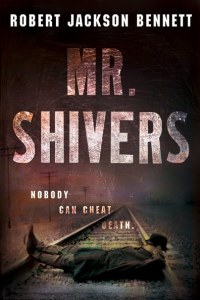
About the Author: Mr. Shivers, published by Orbit, is Bennett’s debut novel. He graduated from University of Texas- Austin and lives there currently. He also writes a blog about the book.
Grade: A-/B+
Mr. Shivers is a novel that starts out as one thing and slowly develops into another. Connelly, a man broken with rage and depression over the murder of his young daughter goes on the road as a vagrant in order to find, and kill, her murderer. A man he saw, with a scarred face that goes by Mr. Shivers.
Along his path he encounters many fantastic myths about the man, none of which he believes- at first.
The story begins as a run of the mill revenge story, one based in reality and set during the Great Depression, but as Connelly gets closer and closer to Mr. Shivers, the story falls deeper into myth, moving away from reality and becoming more magical.
Great Depression Setting:
Bennett draws a pretty basic depression setting. He includes a dust storm, many poor families heading west, and some other generally known details. Overall, the setting is threadbare at best. Bennett’s setting could be during almost any era, except he chose to call it the Great Depression. This was disappointing, as the novel could have felt richer and more realistic with more detailed descriptions. It ended up feeling poorly researched, if at all researched.Connelly as protagonist:
Connelly is a decent protagonist, we want him to achieve his goals but are also shocked and disgusted at some of his actions. He develops well throughout the story, but his background and purpose remain hazy throughout the story. This was a major problem as it left me not really understanding why he was putting himself through the misery of his revenge quest. We are told from the begining that he is revenging his daughter’s murder, but we don’t know how she died or really anything about her. He remembers her smile, her laugh, but we never get a clear memory or piece of the past to visualize how much he loved her.
Another issue I had was that we never see who Connelly was before the murder. Seeing him in his normal state would have done a lot for watching his degredation to what he becomes. Instead we are given a Connelly already broken, and already hardened, having been on the road an unknown period of time before we meet him.
Mr. Shivers as antagonist:
Mr. Shivers, at first just a psychopathic vagrant, then mystical evil death man, works as an interesting antagonist. He is entirely evil from the begining, leaving no room for development. Bennett touches on Mr. Shiver’s past in Connelly’s dreams, where a young Mr. Shivers visits him (though I don’t think we’re suppose to realize that right away). This was a good touch, but just made the ending more obvious and didn’t really add anything to Mr. Shivers as a character.Bennet also uses some Greek symbology and themes throughout the novel. Connelly is going on a strange odyssey, he meets three old wise women who tell him the future, and a white bull (symbolic of life and resurrection but also of death) plays a part towards the end. This is neither here nor there. The symbology he uses is common enough to be immediately recognizable and overused, and bores the accomplished reader.
The end was also predictable, though I am not certain if everyone would find it predictable, I certainly did. A predictable ending is always disappointing, but this story really couldn’t have any other ending. In order not to spoil the ending, I will not elaborate.
With all of that said, it was still an enjoyable read. It’s a qucik and easy read, I would suggest it for high school level reading or for someone who just wants an easy, entertaing story to enjoy.
It’s unfortunate, however, that Bennett didn’t take the extra time to make it richer. It had everything it needed, it just required some extra work. It could have been a work of art instead of the thing you read on an airplane, but then it probably would lose popularity.
-
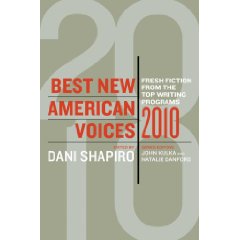
Best New American Voices 2010, Edited by Dani Shapiro

For the past ten years creative writing programs have submitted the best to come out of their programs to be published in the “Best New American Voices” series each year. This year’s edition was edited by memoirist and novelist Dani Shapiro.2010’s edition of Best New American Voices consists of work from:
Boomer Pinches (University of Massachusetts, Amherst), David James Poissant (University of Cincinnati), Claire O’Connor (University of Idaho), Christian Moody (University of Cincinnati), Laura van den Berg (The Bread Loaf Writers’ Conference), Edward Porter (Wisconsin Institute for Creative Writing), Emily Freeman (The Loft Literary Center), Lysley Tenorio (San Jose State University), Timothy Scott (Wisconsin Institute of Creative Writing), Greg Changnon (Sirenland Writers Conference), Ted Thompson (The Bread Loaf Writers Conference), David Lombardi (University of Houston), Leslie Barnard (University of Oregon), Andrew Brininstool (University of Houston), Andrew Malan Milward (University of Iowa), Baird Harper (The School of the Art Institute of Chicago)
Unfortunately, the “best” to come out of these programs generally leave much to be desired. While all of the stories display high writing quality, the content tends to fall on the generic and dull side.
The Best of “The Best”
“Bethlehem is Full’ by Boomer Pinches
B+/A-
A young couple who have recently aborted their baby go on vacation to Australia in order to reconnect and leave the bad memories of the abortion behind them. While in Australia the narrator, the man, realizes their relationship has been forever altered in the negative by the decision they both pretended to be entirely fine with.
This story, while taking place in exotic Australia, does not lean on the many possible cliches a story based in Australia might take on, which I appreciate. The best part of this story is the couple’s relationship with a mangy dog they find on the side of the road. They both fall in love with it immediately (a possible replacement for the aborted child?) but leave it in a pound where it will be put to death in a matter of days. When the woman leaves the man to return to America, he goes back to the pound at first, we think, to save the dog. Instead he requests he be the one to put it down. It’s a shocking ending, and one that can be read into many ways.“Horusville” by Christian Moody
B/B+
This story takes a chance on attempting magical realism- a genre of writing that, in my opinion, is very difficult to do well. Too much magic and you find up in a fantasy story, not enough and it’s just a confusing story. Moody’s story, while not perfect, does a decent job at finding the balance but not a perfect job. “Horusville” is a story about a teenage boy who lives in a town with a forest made of eyes, real watching eyes. He, and most of the townspeople, tend to do their dirtiest deeds in the forest, because everyone wants an audience. There are a lot of themes and concepts Moody could have delved into with this story but didn’t- which is unfortunate. Instead, he used the eyeball trees as more of a backdrop for a different story- one where this boy and his art teacher paint each other naked but never touch. I feel like this story was very ambitious and for that I give Moody credit, but I would like to have seen more. I think Moody is definitely a writer to watch, his writing will surely develop and grow into it’s potential.“The Changing Station” by Edward Porter
A
This is one of those stories that so acutely zeros in on the concepts of humanity and pride. Porter’s main character, Teddy, is an older man who seems to just want to do good by those in his life, regardless of their own emotional damages. He tries to help the women in his life- his girlfriend Maria and her 17 year old daughter who is a mother, and Maria’s daughter’s girlfriend. He builds a beautiful changing station for Maria to use for her daughter’s daughter, but it is rejected. He drives the daughter’s girlfriend to the strip club she was fired from to get her last pay check. While there, the young boss refuses to give it to her and Teddy chooses to humiliate himself in order for her to get it. Porter describes this humiliation in such a way to show what it means to hold such strength while acting weak.“Some Things I’ve Been Meaning to Ask You” by Ted Thompson
A
This is a story about a teenage boy’s regrets after the death of his father. He retells the year before his dad’s death while interjecting questions to his dead father such as, “did you know that was me?” about a school prank, and others. During that year his focus wasn’t on his dad, it was on a girl he had sex with repeatedly but wouldn’t own up to publicly. He made fun of her with his friends and then would go over to her house. In the story boy is owning up to his mistakes and regrets in such a deep way it leaves the reader feeling both disgusted with the boy and heartbroken for him. Thompson does a great job developing his teenage narrator, and his vernacular and tone use in his dialogue is spot on.“Hero” By Leslie Bernard
A-
“Hero” is very similar to “Some Things…” in that it is about a boy who has lost one parent and uses the sex of a unpopular and generally undesirable girl to fill that hole. In this story, the boy’s mother has run off with another man, leaving his father emasculated in the boy’s eyes. He develops a friendship with a “bad girl” that skips school and sleeps with many of the boys. He has his own regrets to sift through by the end, he throws away a year’s worth of homework the girl gives to him to hand in, resulting in her not passing the grade. He also isn’t capable of having sex with her when given the opportunity, something that shames him (and, I would argue, makes him feel emasculated the way he views his dad) and he gets into a car accident, which strangely enough gets him back on the right path both with his father and the girl he decides to make it all up to. I liked this story for the same reason I liked Thompson’s- the connection they both draw between sex and parents, regrets and disappointments.“Intermodal” by Baird Harper
A-
This story was strange for me because I am certain I have read it before, and in fact I had in an issue of Tin House. That being said, I had enjoyed the story then and I did now as well. A boy’s dead beat dad is kicked out and begins living in a storage unit. The boy keeps the secret from his mother, though it is not certain how much the mother really knows about the father. It’s a story of a boy seeing the degradation and truth about his father in a short period of time. He sees his father brutalize a man, destroy his own car, and basically allow his life to dissolve into nothing. Eventually he gets a postcard saying his storage unit was shipped away, with him in it. He receives postcards from all over, but he knows the storage unit hasn’t been shipped because he goes and sees for himself.Some of the other stories not mentioned fell into the “B” category and had their own positive aspects, but this review would be far too long if I went over every story. So here are just the ones that really stood out.
-
The Russian Dreambook of Color and Flight by Gina Ochsner

Grade: B-
About the Author: Gina Ochsner is the author of two collections of short stories, The People I Wanted to Be and The Neccessary Grace to Fall. The Russian Dreambook of Color and Flight is her first novel. Her short stories have been published in all the fancy literary reviews such as The New Yorker, Tin House, and The Kenyon Review.
The Russian Dreambook takes place in post-Soviet Perm, Russia. The story is centered around one dilapidated apartment building and the poverty-stricken people living inside of it. These characters’ interactions with each other is largely what the novel is about, with very long introspective passages from most of the characters about their dreams, burdens, and lives.
The Main Characters, broken down:
Tanya: A 24 year old slightly over weight girl with her head in the clouds- literally and figuratively. She spend hours writing descriptions of air, clouds, and colors in the notebook she carries with her everywhere and dreams of become a flight attendant for a small airline. She is shy and in love with Yuri.
Yuri: A young man whose mind has been bent from war. He wears his dead father’s flight helmet almost all of the time, it is a security blanket of sorts. He is extremely weak-willed and allows himself to be pushed around and even beaten by everyone around him. He lives with his mother, Olga, and his girlfriend Zoya.
Zoya: A greedy, useless pretty girl who does nothing but beg Yuri for babies. She is lazy and rude and nobody likes her. She is not given a perspective chapter, therefore she remains a flat character throughout the novel.
Olga: Yuri’s mother. She’s works a translator at the local newspaper The Red Star rewriting the news to make the Russian government look better. Once in love with languages, Olga now despises them, and hates herself for changing the truth into lies for a living. She misses her dead husband.
Azade: A woman who has been dislocated due to political upheavals. Instead of her proper social standing, she has been reduced to tending to the public latrine the apartment building’s inhabitants use. It provides a living for her but she feels intense shame about it. She feels dirty and the others refuse to socialize with her. Her husband, Mircha, was abusive to her.
She is the mother of Vitek.Vitek: Son of Azade, a scoundrel, swindler, loser. He forces money out of everyone and beats people up. He is the leader of the pack of orphans that hang out at the building. He also does not get a perspective chapter.
Mircha: Abusive husband of Azade. He kills himself by jumping from the top of the building and then comes back as a ghost who wants to tell everyone how to better live their lives, while being his same drunken abusive self.
This novel plays with magical realism and does it in, I would say, a successful way. It’s interwoven with reality in such a tangible way that it is almost believable. A ghost comes back to drink vodka and mock those he mocked while he was living? Why not!
Her language is very flowery at some points, especially while describing the sky, the snow, the settings:“It looked precisely like every other building in a twenty block radius: glum paperweights holding the pavements and old drifts of snow down.” p. 145
Or in the magical thoughts of her characters:
“Though Azade had smelled the upside-down dreams of bats and the warm and weedy dreams of eels, nothing
reeked as much as the dreams of humans.” p. 192Although some of the language she used was very beautiful, she often described disgusting things in great, disgusting, detail. In her Azade chapters she is often talking about the various character’s bowel movements. describing their shit and farts repeatedly and without apology. While this does lend a palpable gritty quality to the narrative, it does turn the stomach to read about excrement repeatedly and in such detail.
At one point, towards the end, Ochsner breaks the fourth wall, a surprising choice due to the feel of the rest of the book. She writes, in the words of Mircha:
“You see, you can’t really make me go away because it’s not part of the story. You need me. I am the conflict, the
plot complication. I am utterly necessary.” p. 335Well, Mircha was wrong on all points. Azade and Tanya destroy Mircha and his ghost disappears, leaving behind no great wisdom and having not changed himself even slightly. He is also not the conflict- each character’s own inner weaknesses are the major conflicts, regardless of any physical battering that occurs from Mircha or Vitek.
Each character has their own inner demons, weaknesses, and broken dreams. At the end of the story, none of that has changed. Their lives are mostly the same (except they ran off all the evil characters, Mircha, Vitek, and Zoya) and are more comfortable with themselves and each other.
I must admit that it took genuine effort to get through this novel. While it was interesting and the language beautifully and creatively written, it’s just a tough book to get through. Most of it is written in long, introspective chapters without much action. I also found the “bad” characters to be extremely flat and underdeveloped which caused them to play simple villian roles, which stood out in a book as complex as this one.
Not enough review for you? Here’s what some other people said:
Viv Groskop, of The Observer:
“This is a crazy adventure of the imagination, both hilarious and occasionally puzzling. With it, Ochsner joins a small but inspiring band of US-based (she lives in Oregon) writers exploring the post-Soviet landscape. This book has echoes of Jonathan Safran Foer’s Everything Is Illuminated, Gary Shteyngart’s laugh-out-loud Absurdistan and Olga Grushin’s more romantic The Dream Life of Sukhanov.”
Irina Reyn, author of What Happened to Anna K.:
“The Russian Dreambook of Color and Flight is a hilariously absurdist and deeply resonant debut novel. Gina Ochsner transforms ordinary lives into something magical and wise and glintingly beautiful.”
-
Lean on Pete by Willy Vlautin

*I read an advance uncorrected proof copy of this novel. It is to be released April 2010.Grade: A
About the author: Willy Vlautin is the author of The Motel Life and Northline. He is also a singer and songwriter of the band Richmond Fontaine, which is not as successful as his writing has been.
Vlautin’s newest novel, Lean on Pete, is a beautifully heartwrenching novel about a 15-year-old boy who has always had to fend for himself, but is left utterly alone when his deadbeat dad dies.
Broke and friendless, Charley Thompson gets a job with a shady character by the name of Del helping him take care of his race horses. It is with one of these horses, Lean on Pete, that Charley builds a devoted friendship. Charley soon realizes that Del plans to sell Pete to men who will kill him, so he steals the horse and leaves Portland, OR and heads towards Wyoming, where he believes his aunt still lives.
The story is a travel narrative and also a portrait of the degradation of a human being. Everything that could go wrong does for poor Charley, and we as readers are forced to endure every hardship and act of kindness along with him:
“I’d seen a lot of things. I’d seen my dad do things. I’d seen him having sex with women. I’d seen him bending women over our couch and ramming into them and I’d seen them in the kitchen sitting on top of him saying things to him. I’d seen him puking his guts out in the sink and snorting cocaine and smoking weed. I saw a woman passed out in the back of our car in nothing but a bra. I saw her pee on the seat. I saw a guy get a broken beer bottle pushed in his face while we were at a daytime barbeque. I’d seen my dad hit my aunt in the face and call her names when all she did was tell him to come back when he wasn’t so drunk and mean. I’d seen him wreck her car and then abandon it. I’d seen him talk to the police. I saw a kid get hit so hard he began to foam at the mouth and go into seizures and I’d seen a kid shoot a dog in the head with a .22. I’d seen another kid tear the pajamas off his sister just so he could see her down there. She was screaming and crying. And I’d seen Del punch a horse as hard as he could and I’d seen a horse break his leg and wobble around on three while the broke one was held on by only skin.” Lean on Pete, p. 121
This quote is a good example of what kinds of things Charley is faced with throughout his life and the novel. He is pushed to his breaking point and has more than one all-time-low moment. But he is a strong character with integrity and pushes through his tribulations to the end.
Vlautin is a writer who likes to pull out the gritty harsh reality of life for his readers. But in showing all the darkness, the small positives burn even brighter and have an intense effect.
When a stranger shows Charley kindness by providing him with food, this small act really comes through as great, because we know how much suffering Charley has gone through, how the hunger eats at him.
Hunger is a repeated theme throughout the book. Charley is “always hungry” as he explains to almost everyone he meets, and everything he eats is specifically drawn out. The hunger is literal (he is homeless and pennyless) but also metaphorical. Charley hungers for more than just food- he hungers for stability, love, school, and most of all a normal childhood.
Vlautin’s characterization is perfect- Charley is a rich protagonist with a myriad of thoughts, emotions, and desires. He is absolutely lovable, even during his darkest moments. The story line also moves along smoothly, giving us new places and people at every turn, showing a cross-section of America usually obscured or ignored.
-
Do Not Deny Me by Jean Thompson

Grade: B
About the author: Jean Thompson is the author of four novels and four collections of short stories. Do Not Deny Me is her most recently published (2009) collection. Kirkus Reviews has compared her to Alice Munro, and she is described as having “dark humor, seductively sharp wit, and uncanny observations about human nature” on her book jacket.
Thompson’s collection of short stories are hit and miss.
Soldiers of Spiritos is a unimaginative portrait of two lonely people-an aging professor and mediocre student, both filled with self-loathing. The characters interact but have no affect on each other, causing the story to be dry, mopey, and generally dull. Thompson does a good job of separating the voices of student and teacher, giving them very distinct tone and vernacular, but goes too far into the ditzy with the student, giving her far too many “like”s between every other word.It’s obvious Thompson is attempting to capture the tone of actual college-aged students, but in print it comes out making not only her characters sound stupid, but she as well.
Wilderness is another unremarkable story. She uses an over-utilized juztaposition by combining a seemingly happy housewife with her long lost cynically divorced friend. It is no shock to find the housewife isn’t happy, and is in fact more trapped than the divorced friend is. It’s a story that’s been told a thousand times, and Thompson doesn’t add much to it.
The only interesting part is how the narrator (cynical divorced friend) interacts with the housewife’s husband. She has a deep hatred of him (mostly pitted in jealousy) but doesn’t explain why. When he drops her off at the airport at the end of the story they have their first real conversation in which the husband tells her (much to her confusion) about his childhood dream of being an architect. It fleshes him out a little, allowing him to have regrets and broken dreams just like the women do. Interjected throughout the story are excerpts from a letter an old boyfriend has sent the narrator. He writes from his cabin in the woods beckoning for her to join him, offering her an unrealistic escape from the life that has so disappointed her. Point taken, but the excerpts don’t add anything worthwhile to the story and only cause a distraction from the main storyline.Mr. Rat is an amusing story about a bad man in a boring office. He thinks of himself as a “trophy date” for a lonely secretary, and is generally self-obsessed and apathetic to the feelings of those around him. The story read as more of a “men suck” rant than anything else.
In Little Brown Bird Thompson redeems herself somewhat. It is a touching story about an older woman with an empty nest who spends all of her free time avoiding her husband and sewing. She meets a young girl that lives nearby and befriends her, teaching her how to sew and having conversations. The girl, however, comes from a broken home visibly impovershed. The girl even alludes that her father is molesting her stepsister. At the end the father moves away with the girl, and the woman is left feeling alone and guilty, because she didn’t do anything to stop him. The story touches on a range of emotions in the older woman: boredom, guilt, hope, fear. The relationship developed between the woman and girl is realistic, not pushed and not over the top. It’s slow, simple, gentle, and heartbreaking when it ends. The reader feels powerless along with the woman as the possibly child molesting father takes the girl away.
The Liberty Tax (about a young couple’s illegal solution to the recession) and Smash (a man gets into a car accident and imagines the others involved) follow with more of the same unexciting dribble.
Escape, a story about a man who has suffered a stroke and has lost his ability to speak and the use of half his body, is comedically tragic. His wife holds him prisoner in his own house and body as vengeance for his past adultery while he tries desperatly to escape. The hatred the husband and wife feel for each other is stinging and palpable. Here is where Thompson’s supposed “dark humor” pokes it’s head out and says “BOO!”
Treehouse is another portait of a depressed man, nothing more. It’s well written and really gets the man’s depression and boredom of life across, but there’s no meat in this story- just gravy.
The title story, Do Not Deny Me, is about the psychic aftermath the narrator, Julie, feels after her boyfriend’s unexpected death. It was engaging, a little sad, but didn’t dip into the melodramatic cliches that death tends to bring about in so many writers. Julie, who may or may not have a psychic link with the dead, rejects her possible “gift” and therefore rejects the perceived ghost of her boyfriend who has been haunting her since his death.
There were some highlights in this collection, but Thompson disappoints with her generic storylines and characters.
-
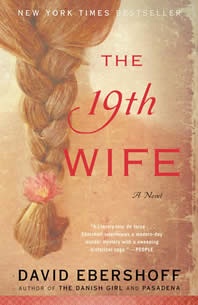
The 19th Wife by David Ebershoff

Grade: A-David Ebershoff is one of the few people who has really succeeded in his career. His name may not be automatically recognizable, but he has accomplished many things and his resume speaks volumes.
He is the author of three other books, The Danish Girl, The Rose City, and Pasadena, none of which I have read so I cannot comment.
The 19th Wife, however, is an international bestseller and can be found in airports across the United States. His novels have been translated into many languages, won many awards, and two of his novels are being adapted for film. Yes, he is hot shit.
He has taught creative writing at New York University and Princeton, and currently teaches in the graduate writing program at Columbia University. Obviously all the fancy schools stand by him. He is also an editor-at-large at Random House.
He has basically won at life. He’s also a brilliant writer. The bastard.
The 19th Wife is a work of fiction which weaves historical facts into a narrative that is both compelling and unique. While following the story of one of the first plural wives of mormonism, Elizabeth Young, you are also in present day time setting following a homosexual ex-Mormon’s quest to solve his father’s murder in order to prove his mother’s innocence. In addition, you are learning about Ann Eliza Young’s crusade to end polygamy in the United States in 1875. Ebershoff proves to us that time travel IS possible, at least in his novel.
What Ebershoff succeeds in so beautifully is weaving multiple stories, settings, and perspectives into one novel. It keeps the reader completely enthralled while learning about Mormonism, a topic most wouldn’t normally run out to the stands to read about.
While the novel doesn’t paint the Mormon religion in a very good light, he gives his characters (even the hateful zealots) depth and empathy. Every character’s actions, however unbelievable or apprehensible, are carefully drawn out so that the reader can see the deeper reasoning behind the actions. To put it simply, Ebershoff’s characters are real people. Their faults, memories, hopes, and regrets are clear. There’s nothing flat or dull about any of them.
The reason I rate the book A- is that there were some lengthy parts (all of which were on the historical side) which were not necessary and very dull. Interjecting pieces of letters from real people (such as a letter from Eliza Young’s father) are interesting but only to a point. They tend to detract from some of the building tension in other parts of the book. Perhaps if they were just better placed within the novel the overall effect would have been improved.
Overall, a very enticing and riveting read.
-
what the world will look like when all the water leaves us by Laura van den Berg
Grade: C+This is a collection of stories by Laura van den Berg, a writer whose talents, according to her book jacket, are “fully formed and spectacular”.
Her book jacket continues to make promises about the stories themselves, calling them “tender, elegant” (Benjamin Percy), “calm, wry, and compassionate” (Brock Clarke).
Ms. van den Berg received her MFA from Emerson College, a prestigious Boston college churning out artistic intellectuals with a rap sheet. Van den Berg’s stories have appeared in many places including Epoch, Best New American Voices 2010, and The Best American Nonrequired Reading 2008.
Van den Berg’s stories, true to the collection’s title, have elements in water running throughout. Hannah Tinti’s claim that she “finds the tension between science and magic and walks it like a tightrope” is very misleading. Her stories, while utilizing exotic travels to Africa (“The Rain Season”) and South America (title story and “goodbye my loveds”) and the people and creatures that dwell there , should not be confused for “magic”.
Her main characters, all female, carry the same voice regardless of who they are, what age they are, and how they are feeling. Van den Berg seems to lack the ability to fully form her characters, and instead they seem to be mere versions of herself. And she must be boring.
Van den Berg utilizes exotic places, animals, and customs to try to hide the fact that the stories and characters themselves are flat, underdeveloped, trite, and dull. Her attempts to display “the human condition” are often cliched and overdone. An older woman haves an affair with a younger man, a failed actress wanders to a strange place trying to find herself, many women nurse broken hearts, and so on.
In “where we must be”, said failed actress takes a job as a bigfoot impersonator and dates a terminally ill man named Jimmy. To van den Berg’s merit, Her main character’s life isn’t resolved and Jimmy doesn’t die at the end. A sappy “this is how I deal with the death of my boyfriend” story would have resulted in a never ending eye roll.
Her use of language is generally basic, nothing spectacular but she knows how to string together a sentence properly. She does, however, invoke some strong images in some of her lines, such as: “I bend over and press my hand between his shoulder blades, feeling the slender ligaments and bones a healthy body conceals.” Now if only it hadn’t followed something so over the top as “I’m being tested, I realize, to see how long I can endure suffering in another person.” Wait, where did the violins come from?
Another story, “we are calling to offer you a fabulous life”, probably should never have been written. It’s a story about a lonely woman having an affair with her boss, the owner of a mask store the narrator works at. He leaves her, she leaves the store with a stolen mask in hand.
Nothing happens. Really. Nothing.
The title of the story comes from a prank call made to the narrator. A call that has no importance to the story other than to repeat the theme that the narrator is a total loser. I find van den Berg makes this mistake repeatedly, inserting little things that are somewhat interesting in themselves, but has no place within the story. Another ploy to create a false sense that her stories are interesting or unique.
One of her stories, “inverness”, takes place in Scotland as another jilted woman nurses her jilted heart. She is looking for a rare flower, the twinflower, while other scientists search out the notorious Loch Ness monster. This might be an intriguing story if the narrator wasn’t constantly blubbering about her exboyfriend and breathing into his answering machine. Even when she finds the flower, it is wilted and unexciting (a metaphor for the narrator’s own dreams and aspirations, and I would argue, a metaphor for van den Berg’s writing).
In nearly all of her stories, van den Berg’s female narrators are weak, incapable of dealing with their own lives and tribulations, and irritatingly whiney. It would be one thing if van den Berg allowed these characters to grow and change throughout her stories, but she doesn’t. She leaves them as paralyzed with heartbreak or confusion as they are from the get-go.
The one story in which she attempts growth within her narrator is in the title story, where her high school aged narrator decides to leave her mother in South America to pursue her own dreams as a long distance swimmer in the United States. But her mother, a cold philandering self-obsessed scientist determined to follow a false theory, shows us another flat, flawed character. The mother has no positive attributes and remains steadfast to the end in her beliefs, allowing her daughter to leave without even a reaction. The daughter’s only real change is that during the story she does what her mother tells her, and at the end she doesn’t. A change, but not enough of a change. The narrator is also so poorly drawn that it is difficult to tell exactly what age she is (is it even legal for her to leave her mother?) or even what she looks like (this only matters in that one of her mother’s beaus makes the moves on her, but even this act is boring).
All in all, van den Berg relies too heavily on foreign countries and exotic items (masks, plants, animals) to carry her stories. Her characters are flat and annoying, and her writing, while obviously honed, lacks the luster it needs to be memorable.




 Bent Shelf Book Reviews