
-
Veronika Decides to Die by Paulo Coelho
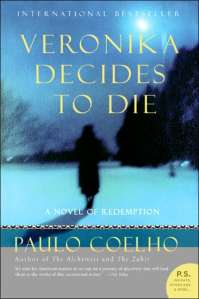 Veronika is a pretty, intelligent young woman who works in a library in Slovenia. She isn’t particularly unhappy, but she isn’t quite happy, either. She is generally bored with life and all of life’s possibilities. This is why, one morning, she ingests a handful of strong sedatives and waits for death to consume her.
Except that, of course, it doesn’t work. Veronika wakes up in a mental hospital called Villete where she is told she has destroyed her heart and has only about a week to live. Instead of trying to end her life again, she chooses to wait out the slow death and interact with some of the other patients in Villete. Among these is the ex-lawyer Mari who suffered from panic attacks, a schizophrenic young man named Eduard, and a woman named Zedka who, after her last dangerous treatment decides it’s time for her to leave Villete.
Many of the patients at Villete stay there because they have grown comfortable there, and don’t want to deal with real life’s difficulties. All of them are affected in some way by Veronika and her slow walk towards death.
I enjoyed this novel, it’s an easy read with short chapters and a very gentle pace. The action is evenly distributed throughout the novel and intermixed with the characters’ insights on life and death. This pace has the result of feeling like you’re on a soft boat ride on a lake, lulled by the fact that you know how it will end, and allows you to enjoy the journey.
There is one wild card in this story, a Dr. Igor, who plays with his patients like puppets in a playhouse. He performs his own psychological experiments on them in hopes of curing what he thinks causes depression: a chemical he calls Vitriol.
This is one of the few books I have read (One Flew Over the Cuckoo’s Nest and Girl, Interrupted are the others) that take place in a mental hospital where the doctors and nurses aren’t heartless villans. They are relatable characters with very natural personalities, doing their jobs but in a humane and understanding way.
Veronika Decides to Die isn’t the depressing suicide tale one might expect from its title, its focus is actually on the hope in life and the many opportunities life has to offer. It has a very Carpe Diem message and ends on a pleasant note.
-
Emerald City Comic Con 2011!
After completing an internship at comic and graphic novel publisher Fantagraphic Books, my interest for comics has only increased. This year I was able to go to my first ever comic convention right here in Seattle. It’s not as big and crazy as the San Diego con, but still pretty awesome.
I only attended one day, Saturday, but the con ran for three days. While there I sat in on a panel with some of the actors from The Guild, and another panel with some of the actors from Buffy the Vampire Slayer. In addition to these panels I walked around the showroom meeting various artists, publishers, and writers. I even bought a few books.
The panels were pretty interesting, but the Buffy panel was a bit on the depressing side. The show has been off the air since 2003, and the only actors at this con were Nicholas Brendan (who has done practically nothing except get divorced since Buffy), James Marsters (who has a limping musical career), and Clare Kramer (who I had never heard of, and was only in 13 episodes of Buffy as a minor baddie). All in all, not the most vibrant crew. Brendan did a lot of the talking, and much like his Xander character, utilized quite a bit of self-deprecating humor in his comments and answers. Marsters played a show after the con, which I did not attend, and Kramer just sat there with a look of embarrassed confusion. Instead of going to a con and sitting through this mediocre panel (which started late and was thus cut short to make way for the following William Shatner panel) I would suggest just watching a video of an older Buffy panel, with more of the cast like this one.
They are still missing some of the major characters (like Giles and Willow) but it’s at least more complete than the one I just saw.
The Guild panel was better, as the show is still on and I learned a lot about the creator (and protagonist) Felicia Day. Not only does she write, act, and do comic books, but she was in some of my favorite shows like Dollhouse and Buffy the Vampire Slayer (albeit in minor roles).
I tried to watch the feature-length fan-made sequel to Serenity (called Browncoats: Redemption) but didn’t make it through more than a couple of minutes of it due to it being really terrible.
While there I chatted with the guys from SofaWolf Press (and bought the latest issue of their literary journal New Fables) and picked up a copy of Vertigo’s Cinderella and Volume 1 of Image’s Elephantmen which Richard Starkings autographed with a drawing for me.
I also gazed upon the face of Questionablecontent‘s Jeph Jacques, the man who has written a comic I’ve been reading since I was 15 years old. The line for his booth was ridiculous most of the day so I didn’t bother to wait in it, but I still saw the guy.
I had a great time at comic con this year, and can’t wait to crack open my new books.
-
Tools of Change: The Publishing Pie, February 15, 2011 (via Margaret Atwood: Year of the Flood)
This is a really great talk from author Margaret Atwood. Enjoy.
-
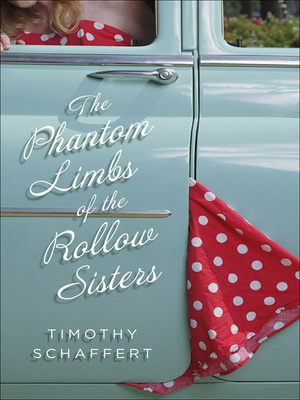
The Phantom Limbs of the Rollow Sisters by Timothy Schaffert
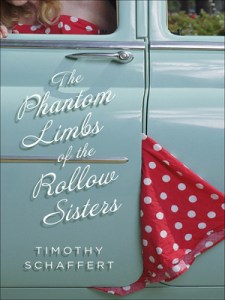 After reading a short story by Timothy Schaffert that I loved I wanted to try some of his longer fiction. The Phantom Limbs of the Rollow Sisters is like drinking a carousel of a boozy hot chocolate: warm, sweet, and at times causes a slight stomach ache.
Lily and Mabel Rollow are sisters who live together in a junk shop they run bequeathed to them by their Florida-retired grandmother. Both sisters feel a little lost and uncertain about their futures, primarily because neither of them has been able to make peace with their pasts. Their father killed himself when they were both very young, causing their mother to abandon them with her mother. After years of the occasional phone call and letter, Lily decides to find their mother, who she knows is now living in Mexico.
Lily and her boyfriend Jordan go on a road trip down to Mexico from Nebraska to find Lilly’s mother, while Mabel is left at home to go on her own kind of journey.
The novel follows both sister’s journeys and quests for answers written in alternating chapters and point of views. In this way we are allowed to explore the rural town in Nebraska where Mabel scavenged for junk while also hitching a ride with Lilly and Jordan through Vegas down into Mexico.
This story was written rather simply, but dealt with the complex issues of death and abandonment and how these things affect different people and their lives. It’s a lovely coming of age story with some really beautiful details woven in, like a dress that is slightly too small for one sister and too big for the other, and how a sleeping boy’s breath smells of whiskey and cherries. Schaffert does a really delightful job of adding in these sensory details to the moments the sisters find important.
This novel would be a good book for a high school reading list, but could also be enjoyed by older readers.
-
Alexandra Kleeman is One Lucky Chick
I don’t typically write posts about individual authors, but an article I read online this week on thedailycamera.com caught my attention.
24-year-old previously unpublished Alexandra Kleeman recently had a short story, “Fairy Tale”, published in the winter 2010 issue of the prestigious Paris Review. For those of you unfamiliar with The Paris Review, it’s is a wonderful literary journal based out of New York City that publishes short fiction, essays, poetry, and interviews by some of the most respected writers around today.
Needless to say, it’s a pretty big deal for someone of Kleeman’s status to be published by it. Interested to see what was so amazing about her story to warrant publication, I picked up the Winter 2010 issue. Not only was her story there, as promised, but it is the first story you turn to.
“Fairy Tale” is a story about a young woman who “wakes up” at her dining room table with her parents and a young man she doesn’t recognize. She is told that she had just been announcing her engagement to said young man before she had stopped speaking. She is, of course, confused as to how she could be engaged to a man she doesn’t recognize. To add to her confusion, young men begin flooding into the house, all insisting that they are her boyfriends. One even brought flowers. Her parents tell her she must choose one, and she chooses the guy that had brought her flowers. In the kitchen, he kisses her and tells her he had come to kill her, then tries to kill her by throwing random articles at her.
The story reads like a dream someone had and then wrote down without much alteration. It’s not that the story was poorly written or terribly horrible, but it was definitely unremarkable and in my opinion, amateurish. It doesn’t hold up to what the media has been saying about it and definitely doesn’t hold up the The Paris Review’s usual standards.
According to the article on thedailycamera.com a professor of hers at Columbia was the one to send the story to The Paris Review. Knowing this, it’s hard not to believe that networking had a great deal to do with her story getting published as opposed to her having some great talent. It’s easy to imagine that same story lost in the stacks of submissions had she sent it in herself.
The Paris Review also has a short interview with Kleeman here.
-
The Awful Possibilities by Christian TeBordo
 The only “awful possibility” is that you pick this book up and read it. Ok, now that’s out of the way, on to what I really think about this collection of short fiction.
It’s entirely unremarkable. It reads a lot like the work of Chuck Palahniuk only where Palahniuk uses short, choppy sentence structure TeBordo uses long, rambling sentence structure. TeBordo’s yawn-worthy horror stories implement mediocre plot twists for cheap shock value. For instance, a rather egotistical man goes to an old friend’s house to demand he make a new wallet for him (with matching handbag for his wife) and by the end he’s snipping the skin off his good old friend’s back to make such items. In another story, a man smokes some cigarettes in his apartment building’s stairwell while he has his wife tied up in his apartment. In yet another, a little kid is taught how to “steal” people’s kidneys. Perhaps I have read too many horror stories, seen too many scary movies, or am simply a bit dark myself but these stories just didn’t do it for me. Anyone can write something grotesque in order to elicit a response. For example: the little girl walked down the street, her backpack bouncing against her body and she skipped over cracks. The extra bounce in her step was due to two things: the A she got on her essay about Abraham Lincoln, and the fact that she had her stepfather’s head in the pack slung over both small shoulders.
Ooooooh creepy, right? No. Simply writing “and then this gross thing happened” doesn’t make you a good horror writer. Another problem was that the voice of each male character was extremely similar, detached and very focused on the thing at hand. This made each character seem like carbon copies of each other.
In between the stories are pages that look like postcards, one side an image (all with an unexplained black goo dripping over them) on the other side some writing. The postcards are connected while the stories aren’t, though the postcards don’t really make much sense, either. They are supposed to be from someone writing to his (or her?) spouse while they are on vacation together detailing what happened that day or a bit of conversation they had. It’s an interesting idea, but isn’t executed very well. They don’t tell a complete story, so they seem to act as just a fun diversion from the typical short fiction format.
I will say that Featherproof Books did a wonderful job putting the book together. It’s small, compact size is handy for slipping into purses or even a large back pocket, and I do like the thing with the postcards. It’s just too bad the content wasn’t as strong as the design of the book.
-
Cloud Atlas by David Mitchell

*warning: contains spoilers
Cloud Atlas, written by the author of The Thousand Autumns of Jacob de Zoet, Black Swan Green, Ghost Written, and Number9Dream, is a collection of stories tied together by similar themes (such as slavery and technological advances), similar location (the Hawaiian islands), and a comet-shaped birthmark that appears on multiple characters’ bodies . Each chapter is dedicated to a new character in a new time told in a new way.
The first story is told from the diary pages of a man named Adam Ewing as he crosses the ocean on a ship filled with unsavory types. He grows weaker and weaker due to a “parasite” in his brain, though we come to find that his doctor “friend” has been slowly poisoning him. Ewing witnesses slavery in multiple countries during his voyage, and while he doesn’t condone the use, he rarely speaks up against it.
The second takes place a little further in the future, told in the form of letters from an “R.F.” to a man named Sixsmith. R.F. is a young, twenty-something young man who has been disinherited and kicked out of his prestigious music school. Broke and generally disliked, he convinces an aging composer to take him on as an amanuensis. While staying at the composer’s home he steals books and sleeps with the man’s wife while strangely falling in love with their daughter.
The third story follows Luisa Rey, a reporter trying to get to the bottom of the death of a man she briefly met, a scientist by the name of Sixsmith (yes, the very man R.F. has been writing letters to). Her story reads like a standard spy novel with a race against the clock and assassins at every turn.
The fourth story is told through the pages of the “memoir” of Timothy Cavendish, a small book publisher on the run from his debtors. He accidentally signs himself into a senior care facility thinking it’s a hotel, where he is then kept prisoner. While forced to stay in the facility he reads a manuscript that had been sent to him right before his flight from London, the very same spy novel featuring Luisa Rey.
The fifth jumps much further into the future, where humans are almost entirely reliant on technology and horrific breeding of servant-humans. It follows the life of Sonmi, a girl genomed to be a server at restaurant called Papa Songs. In this time, “coffee” is referred to as “starbucks” (though I’d argue that language change is already well under way) and shoes are called “nikes”. Largely consumer-based, the culture is broken into two main groups: those with “souls”(a microchip embedded in the skin which is a tracking device and permanent file on the individual), and those made in tubes to serve people with “souls” .
The last story brings us even further into the future, after the collapse of civilization when humanity is reduced to a very primitive existence. It follows a goats herdsman named Zachry, who is telling the story to what seems to be children years after the events he is describing. Because Zachry is telling the story, the entire chapter is written in their strange version of English:
I planted my first babbit up Jayjo from Cutter Foot Dwellin’ under a lemon tree one a-sunn day. Leastways hers was the first what I knowed. Girls get so slywise ’bout who’n’when’n’all…This ain’t a smilesome yarnie, but you asked ’bout m life on Big Island, an’ these mem’ries what are minnowin’ out.
It’s a difficult chapter to read at first, with so many unknown words and slang, but by the end of it the terms become familiar and generally understandable. “Babbit” is “baby”, “smilesome” means basically “happy”, and so on. It was this tough language that became a roadblock of sorts for me as I read this. I sped through the earlier chapters, but this portion slowed me down and at one point almost made me stop reading the book entirely. It is the only chapter that wasn’t split into two parts- it serves as the very center of the novel and therefore goes on the longest. This portion, I felt, went on far too long and could have been edited down considerably.
These five stories aren’t told in complete portions, but actually divided up. The first half of the first four stories are told, then the fifth is told in full, then the other four stories are completed, much like an arc.
The connections between the characters is a little confusing, why they all have the same birthmark is never explained (I inferred that it was meant to suggest all of these characters are the same “soul” reincarnated over the years, but other details dispute that theory). Another connection is that in one story Timothy Cavendish is reading the story of Luisa Rey while in turn Sonmi reads the story of Timothy Cavendish, which had the effect of Russian dolls, each story somehow folding inside of the next one while still remaining almost entirely separate from each other.
While the personal narratives of each character are very engaging, it’s the over-arching themes that are the real meat of this novel. Mitchell seems to have a very strong opinion about humanity and where we are headed as a species. Some of his characters are very flawed and do morally reprehensible things, such as R.F. and his theft from the old composer and adulterous affairs with the same man’s wife. These acts are nothing in comparison to the societies as whole, however, that Mitchell draws out for us. In the past Africans were enslaved for the purpose of labor for the United States and other countries, which is shown through a scene where Adam Ewing witnesses the beating of a misbehaving slave. Later, in the technologically advanced future, slaves are created in tubes and genomed for specific purposes (like serving, or with large eyes for seeing in dark mines) and are used until they have finished their terms as slaves, after which they are executed. In the most distant future, one tribe (the Kona) are most dominant and take slaves from the other, more peaceful, tribes to do their work for them.
Mitchell paints a world in which slavery is an ongoing continuum, regardless of time and how technologically advanced (or primitive) the society is. There are themes aplenty running amok through these stories; this would be a fantastic book for a book club to discuss.
-
Books I Gave Up On
Everyone has them. The books gathering dust on shelves, tossed underneath beds, or accumulating various marks of damage at the bottom of a backpack. The books we begin but do not finish. Those poor works that once held such promise, now left to yellow unread and unloved.
But not, in my case, unwritten about.
I have a reading rule I sometimes adhere to which is: There are millions of books in the world. Do not waste your time on one you don’t like.
Whether or not I stick to this rule is based on the book and the reason I am reading it. Sometimes I force myself to finish books I don’t like because someone asked me to, or because I am proofreading it, or because I am stuck on a plane and that was the only book I brought with me.
However, there are books that warrant a good rule following. Books such as My Mother She Killed Me, My Father He Ate Me edited by Kate Bernheimer, Midnight in the Garden of Good and Evil by John Berendt, and Aloft by Chang-rae Lee. These books passed through my hands, some more briefly than others, and were not finished.
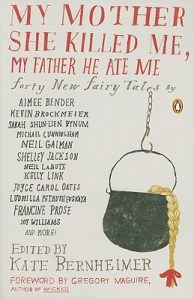
I got a little over half way through the thick volume of short stories My Mother She Killed Me, My Father He Ate Me before setting it down for the last time. I was excited about this book because it was a collection of “modern” fairy tales, and I have always had a soft spot for fairy tales. I grew bored with this book when many of the stories were based off of the same original fairy tale, and therefore ended up being rather similar. Some authors really re-invented the old tales, while others simply re-wrote them. One of the stories I loved, however, was Timothy Schaffert’s “The Mermaid in the Tree” which took place in a coastal town that would frequently have dead mermaids wash up on shore. It told the sad story of a young man who saved and fell in love with a mermaid while his human ex-girlfriend jealously pined away for him. Aside from the few really great stories, I grew bored and realized what I really wanted was just a copy of complete Grimm’s Tales instead of this book.
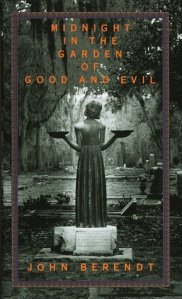
I stopped at page 86 of Midnight in the Garden of Good and Evil. It’s not that this book was immediately dull, it held my attention for a little while before I left it, unopened, for a few months. I honestly can’t recall why I abandoned this book, except that I think it has to do with the return of my boyfriend after a long time apart. I believe another problem was that I had expected this book to be a little scary and thrilling, and instead it was just detailing the town of Savannah, Georgia and introducing some quirky characters. I very well may take this book up again, but not before I explore a few other books’ pages first.
I only got through the first 22 pages of Aloft. Those pages were long dragged out description of an older man buying an airplane and flying it over his house. I just got bored very quickly and abandoned the book for something more interesting. I do feel bad about this one, having barely given it a chance, and I may return to it once I have finished all the other books on my shelf I have yet to get to.

I am currently taking my sweet time with David Mitchell’s Cloud Atlas. It rests now, untouched for days, on my bedside table open to a dragging chapter I can’t seem to get through. Hopefully soon I shall pick it up again and it won’t be added to my list of unfinished books.
-
Flight: Volume One
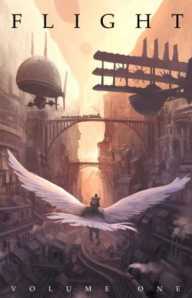 Flipping through the pages of a volume of Flight is like holding a rainbow of joy in your hands. It’s like looking into a magical crystal prism, or swimming in the center of a school of silvery fish.
It fills your heart with a childlike glee, because maybe you just found the one tiny slice of magic left in the world.
You haven’t, of course. It’s just a book, in full color, of comics by multiple artists based on a similar theme: flight. Each short story lasts only a few pages and some have no words at all. Are these the best stories ever told? No. But they are incredibly beautiful to look at.
As of today there are seven volumes of Flight, but I have only read the first volume. I came across this series when I saw the latest volume at the Fantagraphics office and had the opportunity to quickly look through it. Overwhelmed by its bright interior and captivating images, I quickly ran out to Half Price Books here in Seattle and bought the first and third volumes (the only ones they had available). This first volume was enjoyable but I am excited to get to the most recent one as it’s stories seemed more fleshed out than in this first volume.
All of the stories are very different- they range from a text-free story about a penguin who dreams of flying to a story about two girls meeting in a park and talking about kites. There’s another story about a daredevil who solves the mystery of the missing circus python. Each tale is beautifully illustrated and in full-color (printing costs for these books must be incredibly high!) which gives even the simplest story a magical quality.
So help yourself to a slice of magic comic pie and pick up a volume.
-
Buddy Does Seattle by Peter Bagge
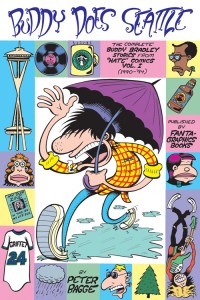 Buddy Does Seattle is a compilation of the Buddy Bradley stories from “Hate” Comics #1-15, years 1990-1994 published by Fantagraphics Books (of course!).
It is heralded by many as a peek into the life of a typical 20-something living in 1990 Seattle, which was the main reason I picked it up. A comic about a 20-something living in Seattle?! That’s just like me! (I thought, as I snapped it up).
Fantagraphics is great because they like to compile books of older comics which make them really accessible for new comic readers such as myself. I’m not really the type that is going to hunt down a bunch of old single issue comics, I want it all in one beautifully bound book. And Fantagraphics delivers.
That said, Buddy Does Seattle wasn’t exactly how I imagined it’d be. There are very little Seattle details (he mentions living on Aurora St. once, I think) which was disappointing because I was hoping there would be some Seattle specifics for me to learn about having just moved to this fair city.
The comic follows Buddy Bradley, a used bookstore employee/band manager/alcoholic loser and his adventures with comics, music, bad roommates, and crazy women. Extremely crazy women. He dates Lisa and Valerie (roommates) off and on who both mysteriously put up with his alcoholism, messiness, and misogynistic tendencies. We’d feel bad for them except they are both totally insane: Lisa cuts all her hair off one day in protest after she has a romantic interlude with her boss (wha?) and Valerie is often found throwing tantrums over nothing.
Overall it’s an enjoyable read, but does get rather repetitive after a while. A person can read about women throwing tantrums, men being jerks, and Stinky’s (Buddy’s sort of best friend) drug use for only so long before it all gets a bit worn out.
Considering I was about four years old when Bagge was writing this strip (and nowhere near Seattle at the time) it’s hard for me to judge if this is an accurate representation of 90’s Seattle. It’s really just a look into the life of any struggling young person who makes mistakes and does way too many drugs. It has it’s downsides, but generally it’s a very funny book worth reading.
Fantagraphics also has a second volume called Buddy Does Jersey which holds “Hate” #16-30.




 Bent Shelf Book Reviews