
-
The Short, Short Hitchhiker by Stanley Gurcze
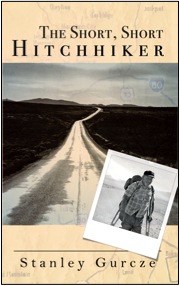 I opened up my small mailbox (just barely big enough to fit one book, ok, maybe two) the other day and inside was this short, short autobiography by a short, short man. The good people over at Virginia Avenue Press had decided to send me their newest title to review, and review it I will.
I’m going to admit, I never would have bought this book had I seen it in a store (or more likely, online). “Not another On the Road! Not another Into the Wild!” I would have exclaimed, rolling my eyes and passing it by. How could I have known that not only was it nothing like those books, but that I would actually enjoy it more than both those highly regarded novels.
The Short, Short Hitchhiker is an unbelievably funny and interesting autobiography by a man, now sadly deceased, named Stanley Gurcze. At an all too brief 136 pages Stanley weaves his many stories of hitchhiking across the United States (mostly through Nevada, Arizona, and Texas) and how he came to be a homeless roamer.
This is the exact opposite of a “woe is me” story, although much woe can be felt from the loss of his legs below the knee when he was young. Aside from that, Stanley is an insightful, amusing storyteller and this book entertains far more than saddens. He describes his travels and interactions with some of the people who pick him up from cops to swindlers to the governor of Nevada. I found myself laughing out loud in amazement at some of the things Stanley wrote about, and was disappointed when the book ended.
This is a little gem of a book written by someone who simply wanted to tell stories, his stories. It’s rare to find a manuscript written purely for the sake of storytelling, without the driving desire to be rich or famous or respected through being a published author. I wish more books had the raw honesty of this memoir, and I highly suggest you all give it a read.
How this book came to be published is almost as good of a story as the book itself. Stanley sent his manuscript to an editor who once gave him a ride, Richard Menzies, who eventually got it published by Nevada publisher Virginia Avenue Press. For more about Menzies and excerpts of the book read aloud, watch here:
-
The Princess Bride by William Goldman
*Warning: Spoilers ahead.
 When I was about ten years old I attended a sleep over party at which I was introduced to the cinematic masterpiece The Princess Bride. Years later, the film remained on my favorite movies list. I introduced the film to as many people as I could: friends, younger siblings, even boyfriends. I still have the DVD sitting among the five other DVDs I currently own.
Needless to say, The Princess Bride had an impact on me. Now, fifteen years after being first introduced to the film, I have read the book it was based on.
William Goldman wrote The Princess Bride in 1973, claiming that it is an abridged version of a novel written by an S. Morgenstern. The book features the story (very close to the film version) and asides from Goldman himself, explaining why he cut certain sections and inserting short personal anecdotes (all of which are fictional).
In the book he mentions that his father read him the “original version” when he was a boy, and now that he has a son of his own he wanted to pass on this tradition. In reality, no such version exists, Goldman doesn’t have a son (he has two daughters), and he of course wrote the book entirely himself.
The story, if you have been living under a rock since 1973, is a fantasy about the love between Buttercup and Westely, and the trials/tribulations they must overcome to be together. If you’ve ever heard anyone say, “My name is Inigo Montoya, you killed my father, prepare to die!” you may cease your wondering: the quote is from this book.
The story is romantic, but mostly it is a comedy. The film features many of the best jokes from the book, but the book has even more comedic elements the film lacks. Goldman’s introduction and asides are incredibly witty, and I found myself more than once laughing out loud (and remember, I’ve seen the movie at least 20 times).
The book also features the back stories of Fezzik and Inigo, a welcome addition to the primary knowledge of the two lovable characters. Prince Humperdinck is also given more character development in the book, as is the relationship he has with Buttercup during Westley’s absence.
The only complaint I have of the book is the depiction of Buttercup. In the film she is certainly the dullest character, but in the book she is described as an absolute moron. Westely and Humperdinck frequently ridicule her lack of intelligence, while she herself is constantly thinking about how stupid she is. She is often described as beautiful and stupid.
I have read that Goldman wrote this story more or less for his daughters (who, it is said, asked for a story about a “bride” and a “princess”). I would think a man writing for his daughters might give them a female character to aspire to, not one to be mocked. That said, his male characters (ALL of the other characters, apart from a witch and the King’s wife, neither of which have much page-time) are very engaging.
Fans of the film won’t be disappointed by the book, and if you have never seen the movie I recommend both highly.
-
The Writer magazine September 2011
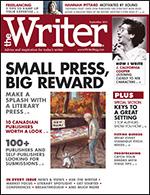 I picked up this magazine while (yet again) browsing the magazine aisle of Barnes & Noble. It’s been some time since the last issue of Poets & Writers came out and I was curious to try out another magazine on writing.
One nifty aspect of this magazine is the “Take Note” section which holds little blurbs throughout that may be of interest to a writer. One is a few short paragraphs on using ellipsis to indicate a pause in dialogue (and what you could do instead). Another is a brief account of how one freelance writer keeps organized, yet another talks about “telling details” in Aimee Bender’s The Particular Sadness of Lemon Cake.
In this section the reader gets a quick look into writing tips, publishing news, and even technology. One interesting short article talked about “Autography,” a new technology that allows authors to “autograph” e-books through downloadable pages. Personally I think this totally defeats the point of getting an autograph, of being able to feel the indentation your favorite writer made with a pen right in front of you. Maybe I’m just a stick in the mud, but not everything can be replaced with a flashy new e-version.
Other sections offer slightly longer pieces (about one page) on topics such as “4 Tips for creating an engaging fantasy series character” and “Why we need pain to write.”
This publication also offers a list of publishers (listed alphabetically) that a writer might want to send their work to.
This magazine is very much for the beginner writer who wants a quick introduction to the world of writing. Designed for those with short attention spans, this magazine holds many different topics which all can be digested in a matter of minutes. Someone with more experience may find this publication to be lacking (it gives an overview of topics and some basic information, but doesn’t delve deeper into its subjects or offer much new information for the seasoned writer).
That said, it’s a great tool for someone looking to learn a little about a lot in one sitting.
-
The Advance
I came across an interesting article at NyMag.com today about debut novel advances. Sure, I knew that at some point in the past publishers shelled out fantastic advances to writers (new and proven alike) for their novels. I had no idea they were still doing it.
According to the article, a laid off copy writer named Chad Harbach recently pulled in a $650,000 advance for his debut novel The Art of Fielding, a book about a gifted shortstop who tries to get his small college to the top of Division III baseball.
Does this novel sound like something I want to run out and buy? No. Would I have ever heard of it at all if its advance wasn’t written about on NyMag.com? Also no. The article also discusses how publishers are using large advances as a marketing ploy: if a publisher is willing to throw down that much money for a novel, it must be good, right?
Not really. Sometimes the books do well, sometimes they don’t make back their publisher’s advances, sometimes they just break even. Only time will tell how Harbach’s baseball tale does in sales, but I can tell you right now it’s going to do much better than if it didn’t get this advance (and consequently, free publicity via NYMag.com).
-
Harry Potter Returns!
Well, sort of.
Fans of the Harry Potter books (and movies) may be interested to hear about a new website, pottermore.com, which is due to launch in October. Early subscribers have already had the chance to try the site out, but the general public will have to wait.
What is Pottermore? Well, according to the site it’s an interactive space made to accompany the books. Read about Publisher Weekly’s Claire Kirch’s experience with the site here. According to Kirch, many of the “new writings” from J.K. Rowling are back stories of some of the more minor characters including Professor McGonagall. In addition, the site has games and other interactive elements that seem geared more towards children than their adult counterparts.
Even though the Harry Potter series is over, it seems it may never really end as this site brings yet another dimension to the Potter tales.
-
The Final Flight
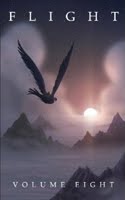 After reading the latest volume of the Flight series (vol. eight) I was skimming through the artist bios when something caught my eye. In many of the bios the authors/artists were bidding farewell to Flight. Apparently, this was the last volume.
Shocked, appalled, heartbroken, I went to the internet to find answers. What I found was very little.
Kazu Kibuishi, the editor of the series from day one, did a brief interview for a blog called The Secret Adventures of WriterGirl in 2010. In the interview Kibuishi states that Flight will probably end with volume eight so that he may focus on Explorer. He also said that he hopes Flight will become a publishing imprint, which will allow him to publish full graphic novels. In another, more recent interview at ComicBookResources.com, Kibuishi reiterates these sentiments but in a slightly more candid way. He talks about how the books were successful (for an anthology) but not very profitable. With a cover price of $27 it is a little steep, but that’s because of the quality of the printing and full color spreads within the book. And honestly, I think it’s worth every penny.
Sadly there isn’t much more information on the Flight series available online, the “official site” is a blog that hasn’t been updated since Oct. 2010. It’s surprising to me how little information was available, it’s almost as if this series was a small flash in the pan instead of the brilliant eight volume series that spanned from 2004-2011.
The last volume contains 18 stories from different artists and all of them are a pleasure to read. Some sad, some hopeful, some cute and funny, (like “Igloohead and Treehead in ‘Accomplishments,’”) they are all beautifully drawn and colored and offer a wonderland for the eyes to enjoy.
If you haven’t yet had the pleasure of this series, I suggest going out and ordering the whole lot of them. They are kid-friendly as well, if you were hoping to get something for that youngster in your life.
Here’s to Kazu, I hope Explorer is half as good as Flight was.
-
More Book Sculptures!
A little while ago I wrote a post about Mike Stilkey’s awesome book sculptures. The managing editor of Line Zero recently opened my eyes to another artist who also does awesome things with books.
Su Blackwell does some really beautiful, mystical sculptures using books. Her work is a little more like fairy tales than Stilkey’s paintings of people and are somewhat like pop-up books.
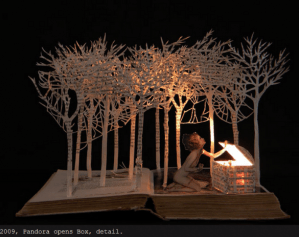 Check out more of her work and some more information about the artist here. While you’re at it, look at the other posts on Lit Stack, it has a lot of great stuff for lovers of books.
 -
The Walking Dead Vol. 2: Miles Behind Us
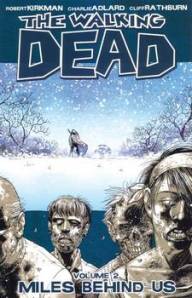 A couple of months ago I began The Walking Dead series with Vol. 1. Though I was impressed by the first book, it took me quite some time to order the second volume. I’m really glad I did.
The second volume, “Miles Behind Us,” continues the story where it left off, with the crew about to head out onto the open road in search of a safer place to live. In this book they come across a few places they (at first) think are perfect until something happens that proves otherwise. In one gated community they are surprised by flocks (herds?) of famished zombies and lose one of their own in the attack. The second place they find (through an unfortunate shooting accident) is a farm inhabited by a family. The father, an older man with four grown children and two little ones, allows the group to stay temporarily. Rick Grimes (our fearless hero) butts heads with the old farmer and by the end of the book the crew are on the road again- sans one young man.
This series is fantastic, it has the horror of the zombie attacks mixed with many different characters from different backgrounds. The authors really focus on how different types of people survive and feel about the zombies, giving a depth to this series that most zombie tales lack. In movie terms it’s much closer to 28 Days Later than Dawn of the Dead.
One of the things I love about this series is that it always keeps me guessing. Characters you are certain will last are quickly killed off, while other seemingly minor characters are given some spotlight. So far it’s been a really fun read and I intend on getting the other volumes soon.
-
The Plight of the English Major
Graduating with a degree in English is kind of like not graduating at all. You still read a lot, you still have no money, and you’re still stuck working minimum wage jobs you hate while pursuing a passion that costs you money rather than making you money. English majors may argue, “But I have finely honed writing skills! Reading comprehension! I laugh at the jokes in Shakespeare plays!” While all of this is fine and good, the “real world” has little space for an over-read recent graduate with a pension for poetry, love for literature, and aptitude for alliteration. Finding lucrative work has always been difficult, and the job options for English graduates pretty limited.
According to payscale.com the ten most popular careers for English majors are: high school teacher, administrative assistant, technical writer, paralegal/legal assistant, marketing coordinator, customer service representative, editor, elementary school teacher, copy editor, and managing editor. Most people will look at that list and focus on the glamorous editing jobs, ignoring the much more realistic (yet depressing) positions as a customer service rep or administrative assistant. The national median pay for these careers range from $35,000 (customer service rep and administrative assistant) to $70,000 (technical writer) with the fun editing careers coming in at around $45,000-$50,000.
All of that information is irrelevant, however, in an economy that has been in a recession since (arguably) 2008. In these “trying times” recent graduates would be lucky to get that first job as a customer service rep. When faced with moving back in with mom and dad and defaulting on thousands of dollars in student loans, answering phones in a cubicle begins to look really appealing.
A recent study released on May 8, 2011 by the John J. Heldrich Center for Workforce Development, Rutgers, The State University of New Jersey, polled 571 2006-2010 graduates from four-year colleges and universities about their current employment status. The results were less than encouraging. Of these students, just over half of them are working in full-time jobs, and half of those lucky kids are working in jobs that do not require a B.A. or B.S. degree. That means an unfathomable amount of college grads are still working as baristas, Gap sweater folders, and waiters. 48% said that if they could go back to college, they would have been more careful about their choice of major. Somehow I doubt it was the business or pre-med students that said this.
While the media has been bombarding us with unemployment statistics that waver from “Yippy! The economy is getting better!” to “Oh wait, now it’s getting worse!” those numbers are just barely grazing the surface of how bad the situation really is. To be considered “employed” by the Bureau of Labor Statistics, an individual needs only to have done “…any work at all for pay or profit during the survey week. This includes all part-time and temporary work, as well as regular full-time, year-round employment.” This means that all of those college graduates working part-time at your local Red Robin are considered employed, with little regard to the quality of the work they are doing…
For the entire article, see the most recent issue of Line Zero.

 Bent Shelf Book Reviews
