
-
The Atlantic: Special Issue Fiction 2011
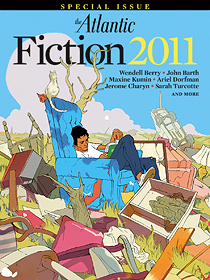 It’s rare that I come across a publication that is 100% perfect. Last week I found one while stuck in an airport in South Carolina.
The $6.99 cover price did make me pause, the magazine was very slim (but also sparsely inhabited by ads) and I haven’t been a huge fan of The Atlantic in the past. Two things made the choice for me: I really needed something else to read on the plane besides F. Scott Fitzgerald’s This Side of Paradise and the cover art. The cover art shows a grungy young man in a gross armchair reading in what looks like a garbage dump. Perched atop the chair is a cat and in the background a bright blue sky. Something about this image really appealed to me and made me want to see what else was inside.
What was inside was nothing short of remarkable. Every piece of fiction was flawless and engaging, beautiful pieces of art were scattered throughout, some illustrated for the stories some not, and two essays which took new perspectives on writing.
Each story was distinct from the others. Ariel Dorfman’s “The Last Copy” was about a man trying to stop his recently published book getting to a certain nun he once had an affair with 20 years ago, “Sold” by Wendell Berry is about an old woman selling off her farm and possessions as she nears the end of her life, Sarah Turcotte’s “Scars” is about a breast cancer survivor and a tattoo artist’s brief encounter, “Vigil” by Stuart Dybek is about a young boy and his father disposing of a large fish on Christmas night, “How to Win an Unwinnable War” by Austin Bunn is about a young boy struggling with his parent’s divorce, “Little Sister” by Jerome Charyn is a particularly creepy story about a woman finding out she has a violent sister locked up in a pricey asylum, “Someone I’d Like You to Meet” by Elizabeth McKenzie is about a young woman bringing her fiance home to meet her intense mother and easy-going father, “L’amour, CA” by Lysley Tenorio is about a Filipino family that moves to the United States and struggles with acclimation, and “The Great Zero” by Jonathan Walter is about a family (primarily father and son) struggling to survive/escape the dust bowl.
Obviously all of these stories are about much more than those brief descriptions, but I’ll leave the exploration of these stories to you. They are really worth reading, each one is compelling and unique.
Bret Anthony Johnston, in his essay “Don’t Write What You Know” dispels the age-old writing rule of writing from personal experience. Johnston discusses ways in which to use personal experience as a place to draw from, but also as a place that needs to be ignored sometimes.
“Do I Repeat Myself?” by John Barth, discusses how throughout history writers have felt trapped by the fact that everything has already been said or written about before.
Both essays are short and give an interesting perspective on these common writer’s problems. I highly suggest this issue to all readers and writers out there, it’s really fantastic and well worth the $6.99.
-
The Alchemist by Paulo Coelho
 According to Coelho’s introduction, Julia Roberts was a huge fan of this book. She wasn’t the only one. The Alchemist has sold more than 20 million copies worldwide and has been translated into fifty-six languages. It’s kind of a big deal.
But that’s not why I chose to read it. I read it because I found it in a stack of free books and recognized the author as the same guy who wrote Veronika Decides to Die and thought it might be an easy, short vacation read for when I was in South Carolina.
It was indeed an easy read, easier than I had anticipated. It reads like a folk tale, following the story of a young sheep herder who is told one day that his treasure awaits him at the Egyptian pyramids. In the story the sheep herder follows the advice of a Gypsy fortune-teller and a strange old man in order to find his treasure. He sells his sheep and heads to Africa where he meets a few friends and a few foes and has his entire fortune stolen from him a few times.
It’s a simple enough fable about the search for happiness. The sheep herder, Santiago, comes close to being very happy a few times and almost gives up on the mysterious treasure that awaits him. But he is told many times that everyone must seek out their “Personal Legend” or they will never be truly happy. He sees a baker whose personal legend was to travel. He spent his whole life working to save up for a great trip and now he’s accepted his lot in life and won’t ever leave the town he lives in.
The story is interesting because it definitely asks the reader questions about their own lives and pursuits of happiness and includes scenarios anyone could relate to. Santiago meets a woman he falls in love with, and wonders if maybe she was his treasure all along. But deep down he knows she’s not, so he must leave her in further pursuit of his Personal Legend/treasure.
This fable is very much a story about perseverance and faith. I’d say it might be a helpful read for anyone having an existential crisis. I can’t promise this book will give you the answers you’re looking for, but it may open your mind to new possibilities or ideas.
-
The Paris Review: Summer 2011
 I’m not one of those people who pretends to read more than I actually I do. So I’m going to admit that I skipped most of the content in the most recent issue of The Paris Review. Is this because I am a lazy reader or is that the content just wasn’t particularly engaging?
I’m going to go with The Paris Review’s summer issue isn’t what it should be. It featured two long interviews with writers I don’t care about (William Gibson and Samuel R. Delany) and the second section of the Roberto Bolano’s serialized novel, “The Third Reich”. Once I have the entire novel I may read it, but too much time passes between issues for me to read each section separately.
One of the items I did enjoy was the poem “Churches” by Kevin Prufer. I’m a self-proclaimed poetry moron, but every now and again I read one that I like. It was a poem that read almost like a very short story about two kids standing in a gift shop in Arizona and the demise of his father.
Another poem, “Arabia,” by Frederick Seidel was more what I’m used to: annoying and contrived. I hate it when poets rhyme unless it’s for children’s books. The last line of the poem is “It looks like spring out there on Broadway meant/Barack Obama to be president.” Really? This is what The Paris Review is publishing these days? Ugh.
There were a couple unremarkable short stories about a drug-induced telephone romance and one about a bitter, divorced man whose daughter hates him. One story I enjoyed was Jonathan Lethem’s “The Empty Room,” a slightly creepy story about growing up in a house where one room is designated as forever empty. The narrator’s father insists it remain empty, but that anyone can use it for whatever they want. In the end, the father’s sanity has dwindled away and the room is used for stranger and stranger purposes.
The art in this issue was from two female artists, Laurel Nakadate and Mika Rottenberg. Rottenberg’s photos and film stills are at least interesting with vivid colors and unattractive people doing normal and sometimes strange things (like smelling flowers, or holding cloth up with toes). Nakadate’s work, however, struck me as being a huge waste of space. She did a series of photos called “365 Days: A Catalogue of Tears” which consists of photos of herself crying. Sometimes she’s naked, sometimes she’s just standing there in a t-shirt, but in all of them she looks like she needs a good slap. The photos are of poor quality and look like a teenager took them with her cellphone for her MySpace page. I’m not a professional art critic by any means, but I just don’t get it.
Needless to say my affection for The Paris Review has been waning lately, and when it’s time to re-subscribe I may decide to pass.
-
Who to Trust on What to Read

How we group “good” and “bad” writing can be really tricky. Each reader brings to a work their own set of values, beliefs, experiences, and tastes. A hardcore Dickinson fan is probably going to look at a new piece of writing differently than a hardcore Philip K. Dick fan.
So how do literary magazines (and even book publishers) make the call? As a reader for Pif Magazine I’ve been thinking about this a lot lately. We have a total of five editors going over submissions, and not all of us always agree on what should (and shouldn’t) be published. At the end of the day, however, I feel that what we choose to publish on the site is really strong writing.
What interests me, though, is the recent summer issue of The Paris Review (full review upcoming). I’ve only read a few of the stories and poems so far, but as I’ve been reading I’ve been thinking about them in a new way: If this was submitted to Pif, would I have accepted it?
What bothers me is that the answer has been mostly no. Now, this could be a number of things. What bothers me the most is the possibility that because I wouldn’t have accepted the piece and The Paris Review obviously did, it means I have a faulty sense of strong writing and storytelling. If that is the case, I should probably choose a different field. Another possibility is that The Paris Review’s standards are faltering, or they have been publishing for some unknown political reasons rather than merit. Yet another possibility is that writing is just too damn subjective. One person loves it, another doesn’t, and neither is wrong.
But in a world with so much content being produced and made available, who do we trust to point us in the right reading direction? Everyone must trust a source to tell them what to read and what to avoid, as most people don’t have the time or energy to wade through all of the available content themselves.
I’ve had a love/hate relationship with The Paris Review, and often find myself unimpressed by the writing they publish. On the other hand, I’m almost always impressed by the selection chosen by Tin House, so it may be to my personal benefit to rely on Tin House as my go-to source for new fiction. I think a fun (albeit spendy) experiment would be to try out as many literary journals as possible and find the one that best suits your own individual tastes and then stick with it. I’ve been attempting this for a few years now, though most smaller journals have failed to catch my interest (to be fair, they only get one shot).
As someone as immersed in reading (and reviewing) as myself, it can be hard to be confident in my own opinions. I try to give fair and informative reviews, highlighting the positive but not letting the negative slip by unchecked, either. I hope I can be a good source for you, my readers, when choosing what to read next.
-
Poets & Writers: The Literary Agents Issue July/August 2011
 If you’re a serious writer (or just want to be one) avoiding Poets & Writers magazine is a huge mistake. Even if the articles aren’t useful, the back of the magazine is filled with current information on grants, awards, contests, and submission deadlines.
As someone who thinks of herself as more of an editor than a writer, some of the content isn’t especially useful for me. I’m not sending out stories or trying to land a publisher for my novel on zombie robots. But I do take an interest in the news and other interesting topics discussed within his magazine (as I have said before in previous posts).
This issue’s focus was literary agents. There was a really helpful article by Betsy Lerner called “How Agents Operate” which gave an inside look on how agents find publishers, network, and work with writers. There was also a round table of interviews with four literary agents, which gave some insight into how they do what they do.
The section I found most interesting, however, was “First Fiction 2011”. It consisted of short interviews with five of the “summer’s best debut fiction” authors. Hearing these new authors (already gaining considerable attention) was helpful and thought-provoking. One author, William Giraldi, spoke about waiting to write your first novel:
“Until Busy Monsters, my fiction was only mediocre. I just wasn’t original, wasn’t good enough in my twenties to publish a book. I had nothing vital happening on the level of the sentence. Busy Monsters is coming out when I’m thirty-six and not twenty-six simply because I was not good enough.”
I found this admission to be really refreshing. Lately it seems like anyone (regardless of age or talent) can write a book and self-publish it either in print or e-book form. Some of this work is worth the trouble, I’d argue most of it isn’t. I think it’s important for writers to be self-aware enough to know when they are good enough to write a novel and when they might need more time reading, learning, and building experiences. I’m glad this author was brave enough to own the fact that he wasn’t good enough at 26. I think more young writers could take a page from his book and in the long run be more successful for it.
What was also great about this section was that it introduced me to new writers and their work in ways I never would have been otherwise.
Some short pieces in this issue were pretty lame, however. A one-page article on how to use Twitter to connect with readers was pretty humdrum, and didn’t really give any information that isn’t already (I believe) common knowledge. Suggestions such as “Categorize your tweets using hashtags” and “tweet twice a day” aren’t exactly hot tips.
-
Reader’s Block
While I took the week off from reading, I am still very much a reader and spent my time trying to start a new book. I tried Muriel Barbery’s The Elegance of the Hedgehog, Jean-Paul Sartre’s Nausea, Thomas Pynchon’s Crying of Lot 49. I barely got through the first few pages of any of them.
People are always talking about “writer’s block,” but rarely do I hear about “reader’s block,” which is what I think I have been experiencing lately. It could be the books I’ve attempted to read are just not my cup of tea, but I think it’s more likely that I have been too distracted. I can’t seem to focus on the books, my mind racing ahead to other topics, other concerns.
I also have a rule that if the book isn’t grabbing me I’m not going to force myself to read it. There are simply far too many books in this world to waste time on ones I don’t like. I may give Crying of Lot 49 another try someday down the road, but I won’t return to Nausea and it’s highly likely I won’t ever get through The Elegance of the Hedgehog. That said, I did finish my latest issue of Poets & Writers last week, and found I could focus on the short articles. I think my brain just isn’t in novel mode right now, I’ll try to read my new issue of Tin House instead.
So what should a reader do when the block settles in? I tried taking a break from reading. I went out with friends, watched some movies, went bowling. But that didn’t stop my desire to read, even if my brain felt too tired to be bothered. I think it’s important to replace reading (if you must) with some other creative pursuit. Today I shall spend my non-reading time enjoying the sun, but also on art and maybe even my own writing. Sometimes blocks, while “blocking” one entrance, can actually be used to chuck through a window.
-
The Books We Leave Behind When We Die
 Recently, my boyfriend has taken up the money-making hobby of book selling. He goes to garage sales and buys books for cheap and then resells them online to companies such as Amazon, Powell’s, and Moola4books.com. Sometimes if I have the morning off I’ll go with him to these sales to see if there is anything I want.
Sometimes we go to estate sales, which typically are open houses held by the adult children of a deceased older person. Among their dusty books and boxes of Depends we often find some good deals (not for the Depends, just books). But it made us both horribly aware of our own mortality: what will become of our own books when we die?
The other day my boyfriend answered an ad on Craigslist for ten boxes of free books. When he arrived at the address, he saw that it was a building for mostly older people. The landlord let him into the basement where boxes and boxes of books were sitting in the dust. After he hauled the load home, we went through the boxes.
Inside were mostly books on history, Billy the Kid, and some classical sheet music. Among the books, however, were lost photographs, letters, and even a diary. One letter we found among the books was particularly interesting. Across the front the words “Haliegh, do not open until morning of Gramma’s last flight”
Inside the envelope was a note from said Gramma, thanking the person for dropping her ashes and offering some last-minute life advice. The envelope had been sealed shut when we got it.
These items inspired many conversations about who these people may have been, what happened to them, why was this letter unread? My boyfriend felt angry at first. “Who can’t be bothered to open a letter from your dead grandma?” he said, appalled. I suggested that maybe she wrote the letter and then died, never putting it into the right hands.
Either way, these lost items of our loved ones speak volumes to who they were when alive, and how we treat our elders. Maybe these people who died didn’t have any children, but it’s hard to understand how family members can just give away loads of things, or sell them, without even sorting through them for personal mementos.
After we sorted through the books, selling off some to websites and others to the local used bookstore, we are left with four medium-sized boxes of books that aren’t worth anything (at least not now). We’ll put them into our own apartment’s storage space until we can think of something to do with them.
-
The Book Sculptures of Mike Stilkey
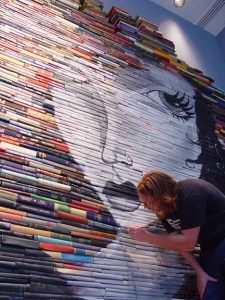
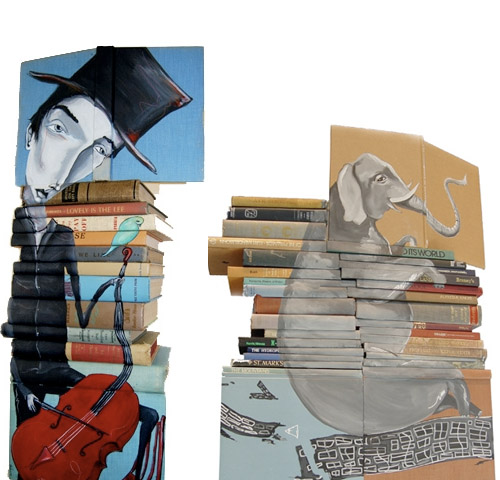
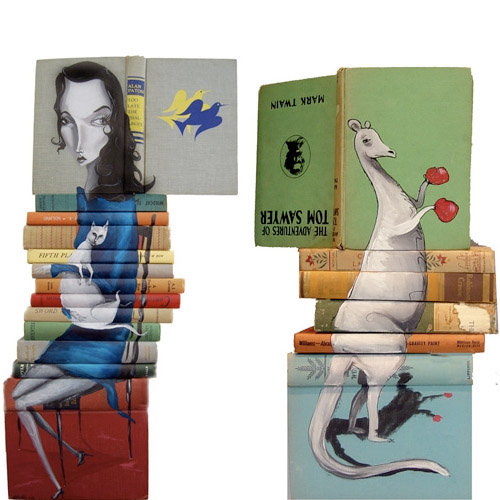
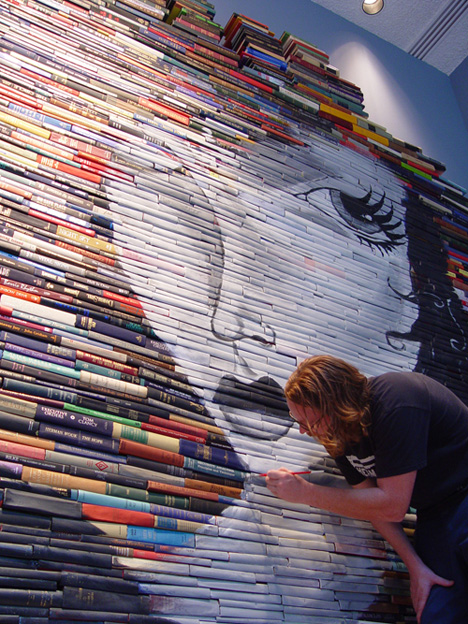
Mike Stilkey, an L.A.-based artist, has been exhibiting his work since 2004. His art, a combination of whimsical people and animals, is painted on everything from canvas to books.
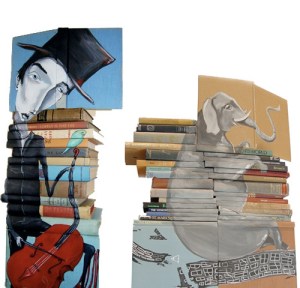 I came across his work somewhat randomly online and can’t get enough of it. I am particularly fond of his paintings of horses.
What makes his work so cool is that they range in size by how many books he chose to use. Check out his gallery here. Stilkey recently did a 12.5 x 10 ft. book sculpture installation in the Porta Nuova Railway Station Torina, Italy.
 He also has a beautiful print for sale called “Sleeping Horse” for $45, in case anyone wanted to buy me a present.
Watch an interview with Stilkey and see more of his work here.
-
The Walking Dead Vol. 1 by Robert Kirkman and Tony Moore
 I was introduced to The Walking Dead through its most recent form: AMC’s t.v. show of the same name. My boyfriend, zombie-obsessed like most young men these days, sat me down to watch it with him.
The t.v. show was pretty interesting, while a lot of the content was nothing new in the world of zombies (same groaning, flesh-eating monsters) the take was a little more mature. I found out the show was based on a comic book and decided to check it out.
The Walking Dead Vol. 1 “Days Gone Bye” introduces the main characters, our hero being Officer Rick Grimes. Grimes was in a coma during the zombie-pocalypse and wakes up without knowing what has happened to the world. He learns quickly, however, and sets out towards Atlanta in hopes of finding his family there.
What he finds is a whole lot of zombies. He also finds a young man who helps him escape and takes him to his little camp of survivors. Among these survivors are his wife and son, and best friend, Shane. The rest is more or less about how they all came to be at the camp and a few power struggles between Shane and Rick.
The comic, while maintaining most of the same characters from the t.v. show, goes different directions in plot. The art is completely black and white, which cuts down on the natural gore that takes place. Obviously there is a lot of blood, but the absence of red tones the violence down a little, making it more palatable.
The dialogue, unlike a lot of Image comics, sounds mostly realistic and doesn’t fall into over-the-top campiness. Overall, I really enjoyed this book and will be ordering the rest (volumes 2-8).
-
The Believer-May 2011 Issue
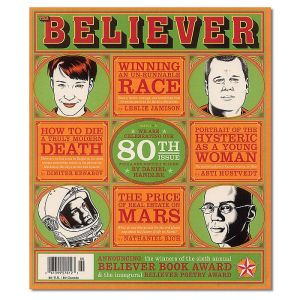 My new favorite thing to do is to drop by Barnes & Noble downtown and examine their magazine collection. I often buy or one two things I don’t typically read, and then read them while the magazines I subscribe to pile up in my mailbox unread.
I can’t help it if I’m an impulse-buyer when it comes to books and magazines. This time I picked up the recent issue of The Believer, which is an interesting publication consisting of mostly essays, some comics, a sprinkle of interviews, and a dash of fiction/poetry.
Reading The Believer reminded me of that Monty Python movie “And Now For Something Completely Different.” There was an essay about Bulgarian “necrologues,” a poem about Manhattan, a brief piece about friendly visits, an article about what Daniel Handler is reading, and a fantastic article about a very strange race.
Leslie Jamison’s “The Immortal Horizon” was the highlight of this issue for me. It describes a race called the “Barkley Marathons,” a treacherous, painful race through horrors unknown in northern Tennessee. The first “race,” the author tells us, happened in 1977 when the man who shot Martin Luther King, Jr. made a prison break. He ran for it, but didn’t get very far through the mud, barbs, and rough terrain. Years later, a man named Gary Cantrell started what he calls the “Barkley Marathons”- a race of ridiculous difficulty and few rules. I’m not going to regurgitate the entire article here for you, but it’s an incredibly interesting story about the race and the crazy people who run it.
The Believer also gave a book and poetry award, one to a book called Next by James Hynes and another to a collection of poetry by Atsuro Riley. Neither of which I have much desire to read based on their summaries. The Believer also publishes book, music, and bureaucratic document reviews, which is pretty interesting. A book they reviewed called Spurious by Lars Iyer struck my attention and I might add it to my already lengthy to-read list.
The Believer definitely has a little bit of something for everyone, and it’s a fun read to flip through, though admittedly I skipped a few of the items and might not pick up another issue for a while.


 Bent Shelf Book Reviews