
-
Bobwhite by Magnolia Porter (a webcomic)
Aside from a previous post about how much I adore webcomics, I haven’t taken the time to do an actual review of one yet. I recently stumbled upon a webcomic by Magnolia Porter called “Bobwhite” about three art students trying to balance their lives of school, relationships, and potential careers. It is a full, completed comic so you can read the whole thing start to finish without waiting for updates.
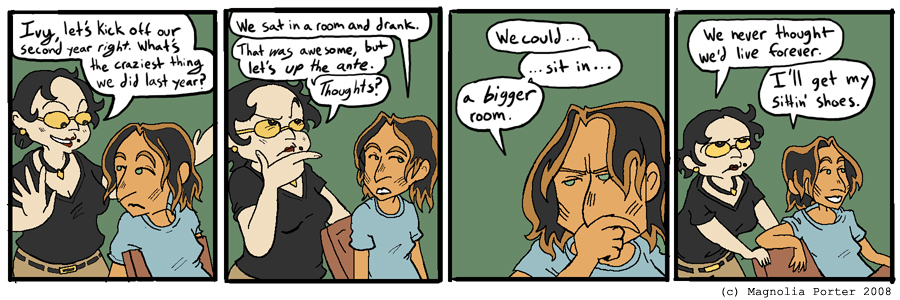
The main characters are sassy film student Marlene, neurotic, boy-obsessed design student Cleo, and the slovenly illustration student Ivy. Each character has some pretty clear character traits, but are fleshed out with family back stories and unique characteristics. The author does a great job creating complex, interesting characters that feel like real people instead of stereotypes.There is some romantic drama, but it’s also a very smart, funny strip about growing up and being in college. It was fun for me to read because I could relate to a lot of the characters’ experiences (dancing to a Peaches song, putting off work, having friends who play the ukulele). It also made me want to be more creative, and maybe I’ll spend some more time on my art.
After a few days of reading the strip pretty religiously, I was really sad to see it end. I was even sadder to see that Porter had been at the Emerald City Comic Con I had attended this year; I missed her and didn’t even know!
I highly suggest you all check out the comic here. She also has two other comics (I haven’t yet read them) called Monster Pulse and Dracula Mystery Club.
-
Ghost World by Daniel Clowes
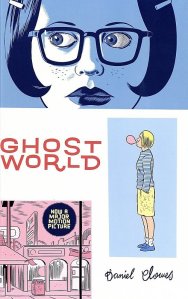 I know, I know. How could I have possibly made it this long without reading Ghost World? The answer is, I saw the movie first.
I remember seeing it in high school and thinking that I would connect with it in some way, but I didn’t. In fact, I think I found it really boring. This resulted in a complete apathy toward the book. Then, the other day at a garage sale, I saw it. I bought the thing for a dollar and read it in one afternoon.
I liked the art, the blue/black/white color schemes and the slightly goofy looking faces of the people. The content was, as I had previously read, a rather accurate rendering of how teenagers talk and interact with each other. It was perhaps this accuracy that turned me off, because the characters are so repulsively self-involved and attention hungry. True, that’s the teenage way of life, but reading a book in which nothing much happens except for two girls talking at each other or making fun of the sad people around them can be a little dragging.
That said, I thought it was a heart-pinching story about two girls in a very close, slightly dysfunctional, relationship coming to grips with growing up and growing apart. The ending panels are both sad and hopeful, and the loud-mouthed Enid’s last words in the book speak volumes to where she’s been and how she’s grown.
It’s a must-read for comic lovers, and I may even give the movie a second chance.
-
American Short Fiction Vol. 14, Issue 51 Spring 2011
 This short volume of new fiction is probably the best compilation of stories I have yet to read. While it only has five stories, each is so masterfully crafted that it’s worth the $10 cover price. Originally published by the University of Texas Press, American Short Fiction is now published by Badgerdog Literary Publishing in Austin, Texas.
Mathew Baker’s “The Wrong Chemicals” was by far the most unique in the collection. At first it seems like a weird narrative with a science fiction philosophy running throughout, but it quickly becomes much more than that. It begins with the “birth” of a man in a basement. Then it goes backwards, as the world in this story goes in reverse. Bombs give life, people are born in cemeteries, and garbage is pulled from the landfills to create cities. Baker does some really interesting things with this premise, adding a dash of social commentary on America (the narrator’s mother tells: “We’ve been sending soldiers overseas for centuries, bringing Libyans to life, Iraqis, Afghanis, pulling bullets from their bodies.” )
The story itself is a rather simple one, a man is unemployed and depressed, but this device Baker uses makes the story into a mystery with a surprising ending.
“Marie Tells All” by Anne Claycomb is a fun (yet troubling) romp through the eyes of a girl who was on a fictional Real World type show called Rock’n Romance. Marie and Teena are twins whose father recently died and decide to go on the show to win the heart of a rockstar they used to have crushes on as teenagers. Marie tells us about what it was “really” like on the show and what wasn’t aired on the episode she presumes we saw.
Michael Fauver’s “Fancier” is about two men who own theaters across the street from each other. Once rivals, now they are just awkward acquaintances with closed businesses. The story isn’t about the theaters so much as it is about the strange relationship between the two men. This was a good story, as they all were, but probably my least favorite. It was also the shortest, merely giving us a snapshot of the men, their relationship, and their lives in those few days.
“Time Apart Together” by Anthony Varallo is another strange story about a college drop out who works as a phone salesman for Great Bank America and has a girlfriend named Ursula he can’t shake. What is interesting is that the narrator makes it clear that he doesn’t care about Ursula and just wants to break up with her, yet he defines everything in his life by her as if she is a point in time he can base everything by. For example: “My parents separated the year I started dating Ursula…”, “I dropped out of college a few months after I started dating Ursula.”
What gives this otherwise humdrum story a lift is that Ursula became interested in him because he looked identical to her ex-boyfriend, Kevin, who she in turn bases her life around.
“The Steam Room” by Shannon Cain is about the Mayor of New York’s wife, Helen, and what happens when she is found masturbating in a public steam room by two teenage girls that go to school with her daughter. In the aftermath of the scandal, Helen is ostracized by parts of her community, embraced by others, and has some enlightening conversations with her children. It’s a great story with quite a few elements, the most important of which is how she relates to her teenage daughter.
-
Poets & Writers May/June 2011 Issue: Writing Contests
 I vaguely recall the first time I picked up an issue of Poets & Writers. I was probably about eleven or twelve years old and I had just come to the conclusion that I was going to be a big writer. I picked up the magazine and set out to learn everything I needed to know from its pages.
At the time, Poets & Writers was what I would call a “fuddy-duddy” magazine, at least from the eyes of a twelve-year-old and didn’t get much out of it. Now, many years later, I couldn’t possibly recommend it more.
The most recent issue’s focus was on writing contests and included an extensive list of contests and due dates in the back of the magazine. The cover story was an interview with four people who run writing contests. While the interview was interesting, it didn’t really give any information I didn’t already know or that was useful to me personally. That said, the rest of the magazine’s content was extremely useful.
Some of the topics discussed that I found interesting were e-book lending/pirating, social media for authors, and navigating literary magazine contracts. Each of these articles were very well-written and informative.
There were also a few author spotlights that discussed each author and gave an excerpt of their work which was nice to read about, though these particular writers weren’t hugely engaging for me personally.
Both the print issue and website are fantastic resources for writers and I highly suggest getting a subscription or at least checking out the website. The website alone has an extensive database of literary journals to submit to (including Line Zero), information on literary agents and grants, and even job listings.
-
Hi Fructose Vol. 19
 After checking out the new Nook Color (eh) at Barnes & Noble I decided to check out the magazine section as well. I must say, B&N has one of the best magazine sections of any bookstore I’ve been to. It always has the literary journals I’m looking for and I often find new magazines I’ve never heard of that are awesome.
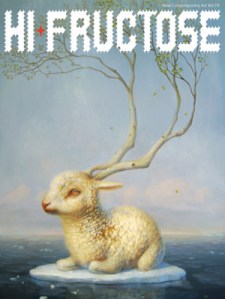
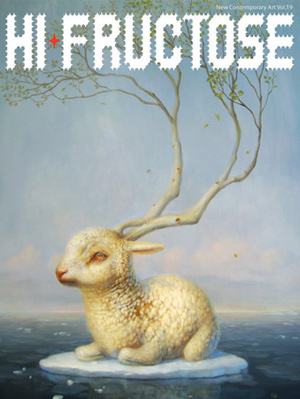
Hi Fructose was one such magazine. The cover art was what attracted me to it at first, and the gorgeous art spreads within were what convinced me to take it home. The magazine is mostly art spreads, with a short accompanying article about the artist whose work is being shown. The cover art belongs to Martin Wittfooth’s apocalypse collection, one of many beautifully rendered images of animals in a post-apocalyptic world. While the cover art was my favorite piece of his, there were also some beautiful images of polar bears on fire, a monkey holding a candle, and a dead fox with bright red flowers growing from its exposed ribcage. While these images may sound gruesome, Wittfoot’s rendering is nothing short of magical.
The other artist that really caught my attention was Kelly Allen. Each piece of her colorful collages is meticulously painted by Allen, which brings several layers to her art form. Each collage includes nature elements like flowers and animals while also including space and drops of color.
Also included in this issue is the trippy art of the Clayton brothers, the word art of Wayne White, Charles Krafft’s “Disasterwear”, the liquidy paintings of Michael Page, the cut up sculptures of Christophe Roberts, and more.
What I love about this magazine is how it exposes quite a few distinct, amazing artists in the most straightforward way possible. They print images of their pieces and run a short but informational article along with it. Those with short attention spans can appreciate the art without getting bogged down by lengthy articles.
Check out a preview of this issue here.
-
Await your Reply by Dan Chaon
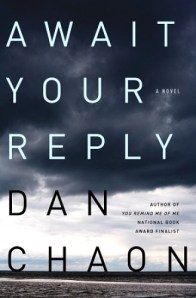 Await Your Reply was the last of Dan Chaon’s work available for me to read. I’ve reviewed his other works, Fitting Ends, Among the Missing, and You Remind Me of Me on this blog as well.
Await Your Reply follows three distinct storylines all revolving around the same theme: identity. Miles Cheshire is searching for his schizophrenic twin brother, Lucy has just run off with her history teacher, and Ryan has dropped out of college to live with the father he had been led to believe was just an uncle. It is unclear almost to the very end how these characters connect to each other, though how they resemble each other is made extremely clear from the first few chapters.
Each character is given an opportunity to remake themselves, to become a different person. Miles struggles with this, unable to be anyone other than who he really is, while Ryan becomes many different people through fake bank accounts and identities. Lucy is pushed by her history teacher lover to take on new identities though she is hesitant.
The stories themselves were engaging (though some more than others, I often found myself wishing Miles would shut up already about his lost brother so I could see how things were going with Lucy in that abandoned Lighthouse Motel she’s forced to live in). The underlying theme of identity felt heavy-handed in many parts, and I often felt like telling Chaon to cool it already, we get it. It also felt as if Chaon merely scratched the surface of “identity” in this novel and that he could have taken the theme to much deeper levels but chose not to for the sake of keeping this novel moving more like a mystery novel than an existentialist one.
While the novel is rather quick-paced and engaging, it’s also deeply sad. Each character is unbelievably lost in not only the world but within themselves. Each pushed by a person in their life (Miles’ brother, Lucy’s lover, Ryan’s father) to be someone they aren’t, to change into someone new. And while they all are unhappy with who they currently are, there isn’t really anyone else they would rather be.
There a few twists and turns towards the end of the novel, but I’ll leave those for you to discover yourself. If you are new to Dan Chaon, I would suggest reading his collection of short fiction Among the Missing and this novel.
-
Tin House: Vol. 12, #3 “The Mysterious”
 The latest issue of Tin House is focused around “The Mysterious.” It has a story about Africa’s Johannesburg, one of the most violent cities in the world, a story about immortality elixirs, an interview with Peter Straub, and some gruesome and creepy fiction.
I loved Luis Alberto Urrea’s short story, “Chametla.” It tells of two soldiers, one who is dying and the other who is watching the man dying. As Guerrero fades from life, Garcia tries to bandage his head wound without much success. Then, something very strange begins to happen:
Garcia bent down, but then had to leap back because a small locomotive rushed out of Guerrero’s wound. It fell out of the wound, pulling a coal car and several small cattle cars as if it were falling off a miniscule bridge in some rail disaster. The soft train fell upon the ground and glistened, puffing like a fish. Casan pounced on it and took it in his mouth, shaking it once and gulping it down.
As Garcia continues to watch the man die, he sees all of Guerrero’s memories flow out of his head, miniature and magical, but solid. I loved this imagery, it comes across as unique and beautiful, as well as troubling.
Peter Straub’s interview was both interesting and inspiring. Straub, author of such scary stories as A Dark Matter, Ghost Story, and Shadowland talked about writing horror stories, his own dark childhood, and how he’s trying to show people how crime/horror stories can be great works of fiction.
One thing Straub said in this interview that caught my attention was when he was talking about what makes things scary. He said, “What would be frightening about me jumping out of the bush wearing a pig mask is not the sudden surprise, but that the ordinary world had split open.” I love the idea of the “ordinary world splitting open” as a metaphor for writing horror or any other type of fiction.
Richard Poplak wrote an essay about “The Suitcase Murder,” a murder that “stunned” South Africa, specifically the scary town of Johannesburg. According to Poplak, “…Johannesburg has produced 1.3 serial killers for every decade of its history, with a cumulative tally of about 450.” That’s a lot of serial killers.
But “The Suitcase Murder” was just a single act of violence that for some reason scared the town more than anything had in a long time. One day a suitcase was found on the shore filled with a woman’s chopped up body parts (sans head).
Poplak describes the story of “The Suitcase Murder” in gruesome but provocative detail adding his insight into the social and economic aspects of the town and the effect of this murder on its people.
Another piece of fiction, “Then,” by Kenneth Calhoun is worth noting as well. The story wasn’t the best that I have read but Calhoun has done something unique here with time traveling. In his story each paragraph is related to a couple and their baby, but the order is all screwed up. In one paragraph the couple are sitting on the couch with the baby, in the next she’s pregnant with the baby, in the next they can’t find the baby. This goes on (a little too long) until the end of the story where cops get involved and the story, which until then had been just confusing and a little dark, becomes very dark and all too clear.
These were my favorite parts of this issue Tin House, but it was a fantastic read as a whole which included many diverse elements under the “mysterious” umbrella.
-
V for Vendetta by Alan Moore and David Lloyd
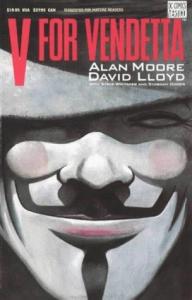 It’s been a science experiments gone wrong/graphic novel week for me. First, I read Elephantmen Vol. 1 and now V for Vendetta.
V for Vendetta is not a new book, it originally came out in the 1980s and had a movie made in 2006 starring the lovely Natalie Portman. So I know anything I have to say about this graphic novel has most likely been said before. I’m going to take a crack at it anyway.
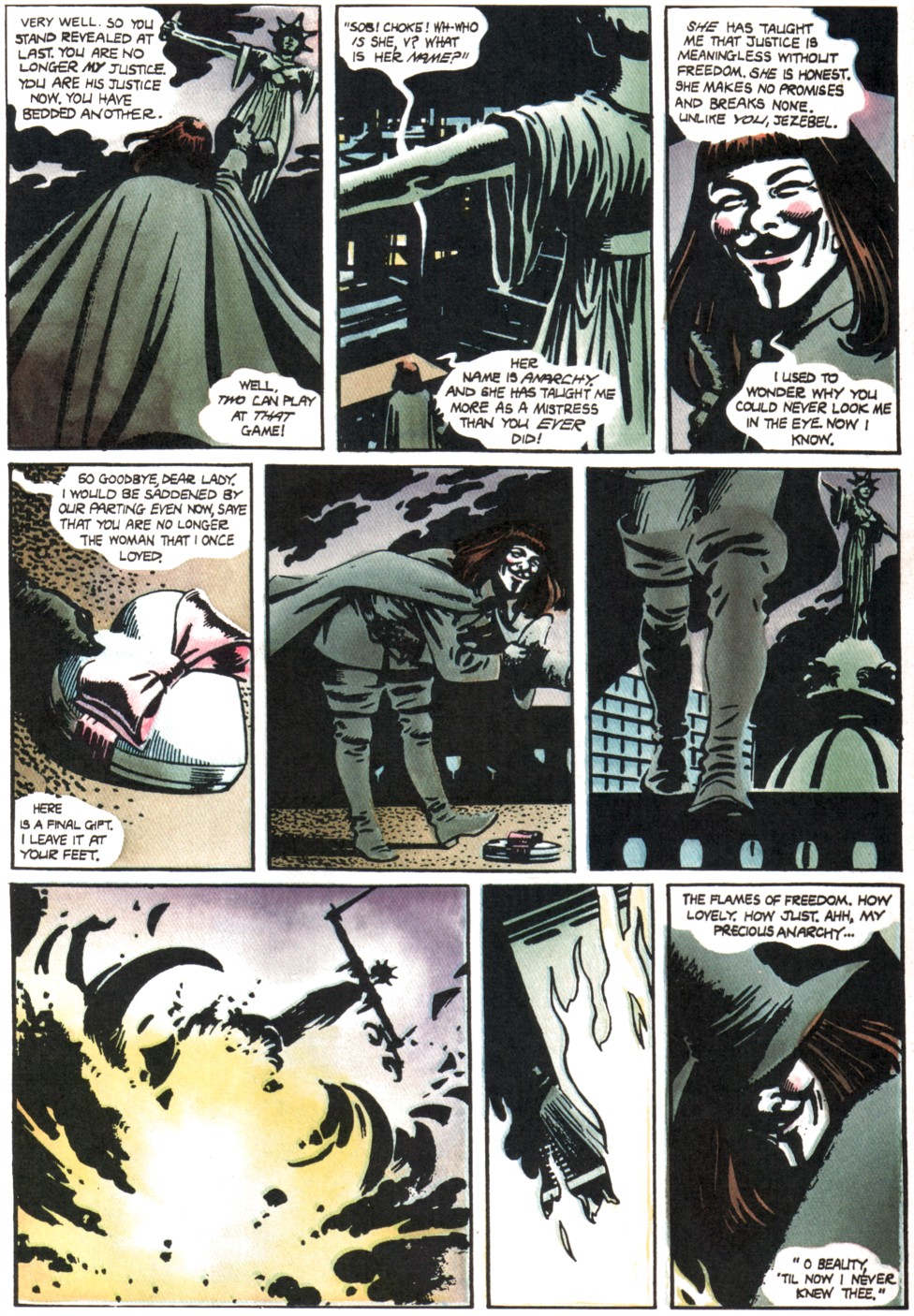
V for Vendetta, if you are unfamiliar with the story, is about a masked man who takes vengeance into his own hands and tries to dismantle the fascist government in England. He systematically kills off head members of the government while taking under his wing a young girl he saves from dirty cops called “fingermen”.
“V,” as the shadowy man is called, is wrapped in mystery and speaks in riddles. His back story is revealed (he was in one of the internment camps in which thousands of people were tortured, killed, and subjected to scientific experiments) but what they did to him we never find out.
The story itself is a familiar one to anyone who read 1984 or any other story about a dystopian society. There are a lot of bad people in power controlling the masses with security cameras and strict laws punishable by death or torture. What makes this story so compelling is how close it is to things that have already happened in our society. The internment camps, the ovens, and the genocide isn’t just a made up horror show. It’s taken straight from history; it’s basically the story of what would have happened had Hitler prevailed.
I enjoyed the book, but I couldn’t help but be disappointed by the lack of information given about V. Yes, I know that seeing his face would have been a disappointment because of “all he could have been” and knowing the gory details of the experiments done to him wouldn’t really add anything to the story, even a more personal background of the character would have taken away his magic. V says himself, at one point, that he is ideas, not a human being. I get it, I like it, I think it was fantastic.
I still wanted more.

The art was also a little disappointing. I’ve been spoiled lately by the smooth glossy pages of the graphic novels being made today, with lush color and imaginative layouts. V for Vendetta is printed on a coarse paper that feels like a thick newspaper stock and is printed in what looks to be solely primary colors (red, yellow, and blue). Many of the drawings are also a little hard to make out, and some of the characters look so similar it’s hard to keep track of them.
If you’re new to graphic novels, or even just new to Alan Moore, I would suggest picking up Watchmen first and then this one.
-
The Dangers of Tandem Writing
The Dangers of Tandem Writing.
I found this story recently while searching for something online. It’s the hilarious result of two creative writing students who are paired up to write a tandem story together (where one writer begins a story and the other takes over after one paragraph back and forth until the end).
If you need a good laugh, read this (it’s pretty short).
-
Elephantmen Vol.1
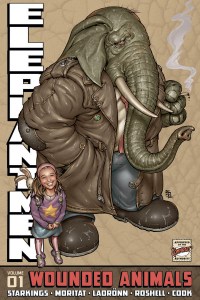 I first saw an ad for the Elephantmen series on the back of a single issue comic book while I was doing some shelving for Fantagraphics Books. I was immediately drawn into the picture of the elephant-headed man in a leather jacket and boots. It felt very noir-meets-animorphs to me, and I made a mental note to check out the series.
Months passed and I forgot about the ad I saw until March when I attended Seattle’s Emerald City Comic Con. While walking through the many booths I saw a large poster with the familiar Elephantmen characters on it and made my way over. There I purchased the thick, heavy first volume of the series and had it signed by the writer and letterer, Richard Starkings.
I’ve only now gotten around to reading it, and I have to say it’s a little mediocre, due largely to the fact that it’s a compilation of single issue comics and not an originally designed graphic novel. It jumps a lot between characters (which can be expected when introducing the main characters) and does a bit of development on their origin story which is interesting. My main criticism is that it doesn’t do enough to start a current story arc, although it could be easily argued that only so much can be done in this amount of space.
What we get from this first volume is that the Elephantmen (particularly a hippo-headed Hip Flask, an elephant-headed Ebony Hide, and a rhino-headed Obadiah Horn) were created by a mad scientist type in Africa through genetic experiments forced into kidnapped women’s uteri. Trained from birth to be “the perfect soldiers” (an overly familiar story concept) they are brutal and strong and eventually escape with the help of the U.S. government. After their escape, they are helped to assimilate into society, but obviously many humans aren’t too keen on that. Not all humans are afraid of the elephantmen, though. One little girl becomes quite fond of Ebony after one meeting, and the world is enraged when a human woman becomes engaged to Obadiah Horn.
I love the art style, and I like the idea of animal-human hybrids. I’m sure the present-day story arc takes off in the second volume, but for some reason I just don’t feel invested enough in these characters to buy the next volume to see what happens to them (and at $20 a volume, with a total of 3 volumes available, one must be pretty invested).
I’m not necessarily calling it quits on this series, but I can say I won’t be rushing out to by the next one, either. I’ll give it a little time before deciding on whether to continue with this series.


 Bent Shelf Book Reviews